Skip to main contentBiographyLABEL:
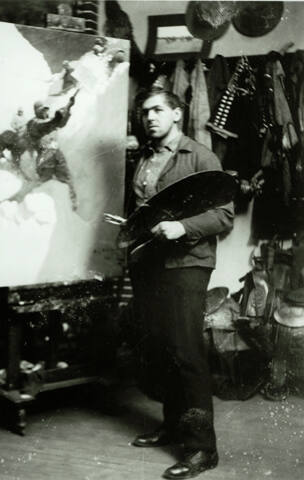
Andrew Wyeth (born in 1917) showed a remarkable ability to draw at a very early age. His only instruction in art came from his father, the illustrator N. C. Wyeth. N. C. encouraged creativity in each of his children and exposed them to literature and music as well as art.
N. C. Wyeth's death in 1945 helped shape the character of Andrew's art. Andrew comments: "We had a wonderful friendship....When he died, I was just a clever watercolorist-lots of swish and swash.... Now I had this terrific urge to prove that what he had started in me was not in vain-to really do something serious."
Wyeth paints in Pennsylvania and Maine, choosing only subjects to which he feels emotionally as well as physically close. In Chadds Ford, Andrew has painted the farm of German soldier and immigrant Karl Kuerner for more than sixty years. The pictures of German immigrant Helga Testorf derive from the Kuerner experience, as do many other works.
The Olson farm on the Maine coast served as a model for Wyeth in much the same way. It was the inspiration for the artist's well-known tempera Christina's World (in the collection of the Museum of Modern Art, New York). After Christina Olson's death, Wyeth painted Siri Erickson, a young woman who became for him a symbol of youth and rebirth.
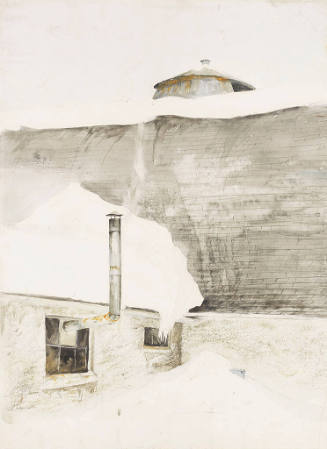
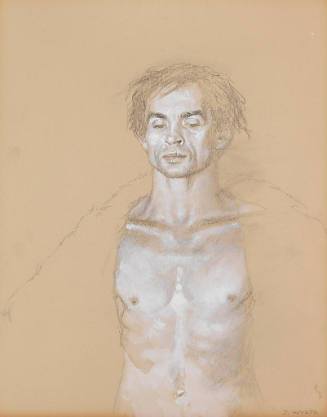
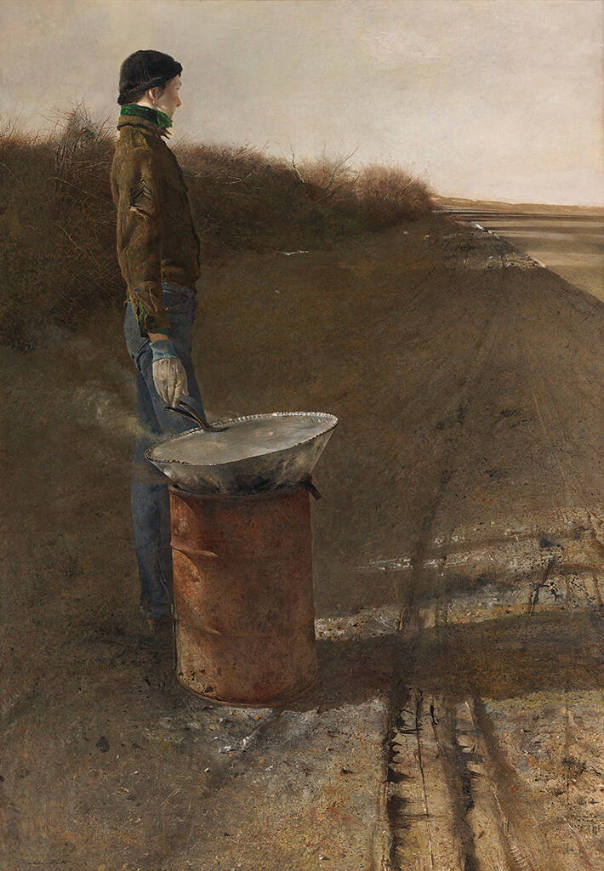
Wyeth uses different media for different types of expression. Watercolor provides a quick response, capturing a moment in a changing landscape. In drybrush watercolor, Wyeth squeezes most of the moisture from the brush before painting, which allows him to render fine detail and contrasting texture. Wyeth's primary medium is egg tempera in which powdered pigments are mixed with egg yolk and distilled water. As he builds layers of paint with this exacting and time-consuming medium, he develops the precise detail for which his work is often recognized.
Andrew Wyeth's art often appears mysterious or melancholic; his use of abstract shapes and complex compositions creates subtle moods. In the personal nature of his subjects he reveals universal themes which communicate to a wide audience.




Andrew Wyeth
American, 1917 - 2009
Andrew Wyeth (born in 1917) showed a remarkable ability to draw at a very early age. His only instruction in art came from his father, the illustrator N. C. Wyeth. N. C. encouraged creativity in each of his children and exposed them to literature and music as well as art.
N. C. Wyeth's death in 1945 helped shape the character of Andrew's art. Andrew comments: "We had a wonderful friendship....When he died, I was just a clever watercolorist-lots of swish and swash.... Now I had this terrific urge to prove that what he had started in me was not in vain-to really do something serious."
Wyeth paints in Pennsylvania and Maine, choosing only subjects to which he feels emotionally as well as physically close. In Chadds Ford, Andrew has painted the farm of German soldier and immigrant Karl Kuerner for more than sixty years. The pictures of German immigrant Helga Testorf derive from the Kuerner experience, as do many other works.
The Olson farm on the Maine coast served as a model for Wyeth in much the same way. It was the inspiration for the artist's well-known tempera Christina's World (in the collection of the Museum of Modern Art, New York). After Christina Olson's death, Wyeth painted Siri Erickson, a young woman who became for him a symbol of youth and rebirth.
Wyeth uses different media for different types of expression. Watercolor provides a quick response, capturing a moment in a changing landscape. In drybrush watercolor, Wyeth squeezes most of the moisture from the brush before painting, which allows him to render fine detail and contrasting texture. Wyeth's primary medium is egg tempera in which powdered pigments are mixed with egg yolk and distilled water. As he builds layers of paint with this exacting and time-consuming medium, he develops the precise detail for which his work is often recognized.
Andrew Wyeth's art often appears mysterious or melancholic; his use of abstract shapes and complex compositions creates subtle moods. In the personal nature of his subjects he reveals universal themes which communicate to a wide audience.
Person TypeIndividual
Terms
- painters
- male
- egg tempera
- watercolor
American, 1878 - 1938