Felix Octavius Carr Darley
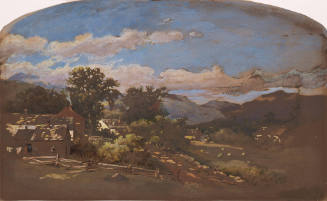
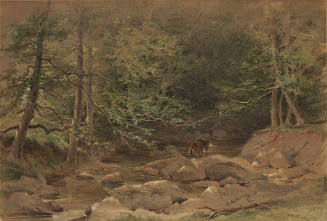
Darley was born in Philadelphia, PA in 1821 and lived there until 1849 when he moved to New York to be closer to the publishers as his fame increased. When he married in 1859, he moved to Claymont, Delaware (7 miles North of Wilmington, Delaware -- 20 miles South of Philadelphia.) where he spent the last 29 years of his life (and almost two thirds of his career). Many of his famous drawings were done from his studio in "The Wrens Nest" (as he named his estate). By the time he married, however, in 1859, he was ready to move from the city to a simpler life, one that involved horses, cows, rivers, creeks, hunting, visits to the seashore, and simply a slower pace.
After marrying Miss Jane Colburn of Cambridge, Massachusetts, they moved to rural Claymont, Delaware. Surprisingly, they joined Felix's two brothers and two sisters who had moved to Claymont into a manor house, The Chimneys in 1843.
Darley lived, and worked the last twenty nine years of his illustrious career in Claymont (ie., ~ 65% of his career), where he died, pencil in hand, in 1888.
A well known "Delaware" artist, Howard Pyle, was seven years old when Darley moved to Delaware. Pyle lived in Wilmington, Delaware, about seven miles from Darley's estate.
Pyle, famous in his own rights, was instructor to N.C. Wyeth. Some, including Pitz, in his book, The Brandywine Tradition, states that the young Pyle was influenced by Darley, although he did evolved into a new, and different style of illustration.
After moving to Claymont, Delaware, in 1859 (to "The Chimneys" manor house), Darley changed the name of the estate to "The Wren's Nest" in reference to his wife, who he referred to as Jenny Wren.
Felix continued his career in his "Wren's Nest" studio and the fields around Naaman's creek and the Delaware River. He only had to walk a short distance down the hill to board the train to Philadelphia, New York, and Boston for visits to publishers and literary friends.
Felix died at The Wren's Nest in 1888, almost with pen in hand. Mrs. Darley lived there until her death in 1916.
;EVERY EVENING--WILMINGTON DELAWARE,
WEDNESDAY MARCH 28, 1888
DEATH OF F. O. C. DARLEY
The Eminent Designer and illustrator Dies Suddenly of Heart Disease.
Felix O. C. Darley, the celebrated designer and illustrator of many of the principal works of prominent publishers of Philadelphia and New York, died suddenly of heart disease at "Wren's Nest," Claymont, yesterday afternoon.
Mr. Darley was born in Philadelphia, June 23d, 1822, (( EDITOR"S NOTE: actual was "1821" )) and was a son of John Darley, the actor. At the age of 14 years the subject of this sketch was placed in a mercantile house, but spent his leisure time in drawing.
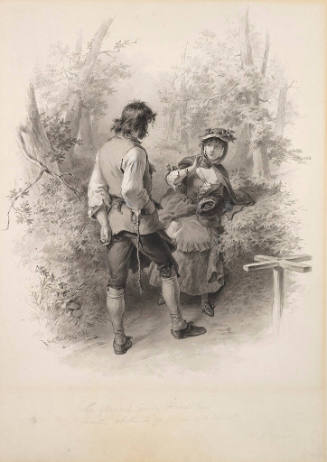
Some of the humorous sketches attracted attention and he received from the publisher of the SATURDAY MUSEUM (Editor's note: ie., edited by Edgar Allan Poe) a handsome sum for a few designs, which encouraged him to devote himself to art. For several years he was employed by large publishing houses in Philadelphia, during which he produced the series of drawings for the "Library of Humourous American Works, " which became very popular in the southern and western states.
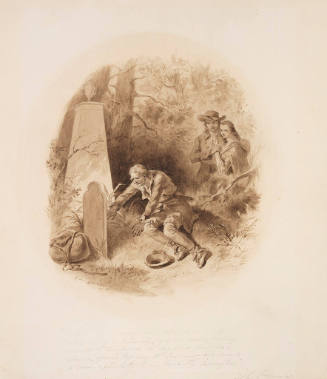
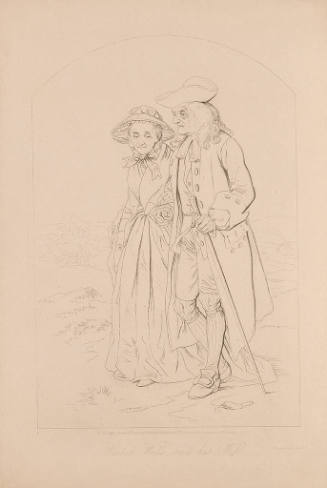
In 1848 he removed to New York and occupied himself in illustrating Irving's humourous writings. In 1856 he published a series of designs in outline from Sylvester Judd's novel of "Margaret," which met with such favor that he was commissioned by the American Art Union to illustrate in similar style "Rip Van Winkle" and "Sleepy Hollow." His elaborate outline drawings of these subjects led to his recognition both at home and abroad as a worthy successor of Retzsch and Flaxman.
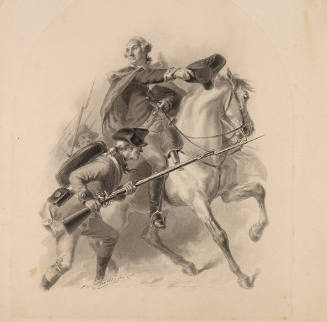
He declined an advantageous offer to settle in London, and applied himself assiduously to his art. In addition to illustrating James Fenimore Cooper's works, for which he furnished more than 500 designs, he was also engaged in the preparation of vignettes for bank notes. He also illustrated Dickens' works and Simms' novels, and executed the "Massacre of Wyoming," and various Revolutionary pieces.
Mr. Darley was elected a member of the Academy of Design in 1852, became a member of the Artist's Fund Society, and was one of the early members of the American Society of Painters in Water-colors. In 1859 appeared his drawing of the wedding procession in Longfellow's "Courtship of Miles Standish." Since then he has executed many large works, among which were four ordered by Prince Napoleon, viz: "Emigrants attacked by Indians on the Prairie," The Village Blacksmith," "The Unwilling Laborer," and "The Repose."
During the civil war he delineated many dramatic and characteristic scenes including one representing "Dahlgren's Charge at Fredericksburg." and another representing "Sherman's March to the Sea." Some of the most elaborate figures and scenes on the government bonds and legal tender notes of the national banks were designed by him.
Toward the close of the war he visited Europe, added many scores of sketches to his portfolio, studied models in Rome, and made a large number of drawings, many of which appeared in periodicals. On his return to the United States he published "Sketches Abroad with Pen and Pencil" (New York 1868) for which he furnished both letter-press and illustrations. His "Cavalry Charge at Fredericksburg, Va.," was at the Paris exposition of 1867. His "Street Scene in Rome," in water-color, was at the centennial exhibition of 1876.
In 1875 he engage in preparing 500 drawings to illustrate a "History of the United States," by B. J. Lossing. His later work consists of "Outlines to the 'Scarlet Letter" of Hawthorne (1879) and 12 outline illustrations to the "Evangeline" of Longfellow, issued, not in lithograph print as heretofore, but in phototypes, taken from the originals (1833), and "Illustrations to Shakespeare's Plays" (1886). He also illustrated several volumes published by Porter & Coates of Philadelphia, and at the time of his death was engaged on an edition of Dickens, now in preparation by the same publishers.
About 35 or 40 years ago he removed to Claymont, (Editor's note: 1859) where he has since resided and pursued his artistic work. He leaves a wife, but no children.
From the Wilmington Library
Carol Digel
... Send via E-Mail to Carol
Researcher and Historian,
THE DARLEY SOCIETY, INC.
Claymont, Delaware USA
;Born June 23, 1821; died March 27, 1888