William Henry Dethlef Koerner
This biography was submitted by Thomas Nygard Gallery
W.H.D. Koerner was brought to Clinton, Iowa in 1880 from his birthplace of Lunden, Germany. By 1896 he was a staff artist at the "Chicago Tribune", earning $5.00 a day. Following attendance at the Art Institute of Chicago and the Francis Smith Art Academy, he was art editor of a literary magazine in Battle Creek, Michigan. From 1905-1907 he studied at the Art Students League in New York City.
In 1907 he moved to Wilmington, Delaware, working until 1911 as an illustrator under the tutelage of Howard Pyle, along with N.C. Wyeth and Harvey Dunn. By the 1920's, Koerner was one of the best known magazine and book illustrators. His study with Frank Breckenridge had provided the use of "broken color" and "commercial impressionism," and with these two assets, his palette became full and vibrant.
In 1922 Koerner was given the commission to illustrate Emerson Hough's "The Covered Wagon", published serially by the "Saturday Evening Post". By 1924 he was spending his summers in a log cabin near the Crow Indian Reservation in southern Montana. He also visited California and the Southwest. Koerner became truly the "illustrator of the eastern myth, of symbols of an earlier, less complicated, infinitely more moral land of ample time and room to roam."
He received $1,000.00 for cover illustration for the "Post", an extraordinary sum for the time. His painting garb was a smock over his knickers and golf socks with saddle shoes. After his death, hundreds of painting were in his studio, along with drawings, sketchbooks, and artifacts. His widow kept the studio intact until 1962, when exhibitions demonstrated that Koerner had been an important Western painter. The studio is now displayed intact at the Buffalo Bill Historical Center's Whitney Museum of Western Art in Cody, Wyoming.
This biography was submitted by Altermann Galleries
W.H.D Koerner was regarded as one of the most capable and prolific illustrators of the mythical American West. Born in Germany, he immigrated with his family to the United States in 1880, settling in Iowa. Koerner made his way to Chicago in 1898 and worked as a newspaper illustrator for the Chicago Tribune, covering many assignments and developing a sure, rapid hand as a draftsman. By 1901 he was attending classes at the Chicago Art Institute, and four years later enrolled in the Art Students League in New York.
A major step in Koerner’s career occurred when he was accepted for formal instruction by Howard Pyle, the famed illustrator who had also taught N.C. Wyeth. In 1919, he built a permanent home and studio in Interlaken, New Jersey, and settled into a busy life as a famous artist much in demand.
In 1924, Koerner made is first trip to the trans-Missouri West by car a seven passenger Buick equipped with camping supplies. He went as far as Cooke City, Montana, near the northern section of Yellowstone Park. Koerner hiked in the high mountains and worked excitedly, inspired by his surrounding. In the next few years he traveled to California via the Santa Fe Railway, sketching throughout the Southwest. In 1927, he also participated in a pack trip into the Big Horn Mountains of Wyoming. Koerner absorbed everything he saw, making countless sketches and using a camera to help him record details of cowboy life and the waning existence of the Indians on their reservations.
In 1928, Koerner’s fame as an illustrator was at its peak. Among the many authors for whom he illustrated was Zane Grey, the most popular western writer of his time. Grey was particularly fond of the artist’s work and owned some of the “square-ups,” or working drawings, which Koerner had done for his magazine stories. Another popular writer with whom Koerner worked in the 1920s was Hal G. Evarts; in 1928-29 he completed the illustrations for Evarts’ serial, “Tomahawk Rights,” about he settling of the Old Northwest.
Resources: The American West: Legendary Artists of the Frontier, Dr. Rick Stewart, Hawthorne Publishing Company, 1986
--------------------------------------------------------------------------------
This biography from the archives of AskART.com.
Born in Lunden, Germany, William Koerner was a noted magazine and book illustrator whose work was characterized by strong draftsmanship and an eye for detail.
He immigrated with his family to the United States in 1880, and they settled in Clinton, Iowa. At age 20, he became a rapid-hand illustrator for the "Chicago Tribune." By 1901, he was attending classes at the Art Institute in Chicago, and four years later enrolled in the Art Students League in New York. When illustrator Howard Pyle accepted him for formal instruction, it was a major career boost.
In 1924, Koerner first went West, traveling in a seven passenger Buick. He camped extensively and continued to travel to California via the Santa Fe Railroad. Zane Grey, popular novelist, used his illustrations in his novels. Koerner worked primarily from New York but kept a summer studio near the Crow reservation in Montana.
He settled in Interlachen, New Jersey and built a studio there, which is replicated at the Buffalo Bill Historical Center in Cody, Wyoming.
---------------------------------------------------------------------
The following is from the Art Cellar Exchange of San Diego, California:
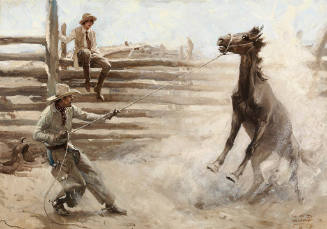
William Henry Dethlef Koerner is known as a Western Illustrator, despite the fact he spent most of his life in the mid-western and eastern United States. His works have played a significant role in the development of American art and iconography. Koerner's images of his favorite subjects, cowboys and Indians, couples, round-ups, and the various dramas surrounding them, enhance the legend of the American West that continues to fascinate people around the globe.
"Big Bill," as Koerner was known by friends, was the son of poor immigrants and lived in Clinton, Iowa for the first sixteen years of his life. It was obvious at an early age that Koerner possessed tremendous artistic talent. When he was 18, his father encouraged him to move to Chicago to pursue a career art. Koerner was quickly hired as a staff artist by the Chicago Tribune, earning $5 a week. While in Chicago Koerner also studied at the Francis Smith Art Academy and the Art Institute.
Eager to aide their son's success, the Koerner family moved to New York City in 1905, enabling William to study at the Art Students League. After two years as a student in New York, the artist moved to Wilmington Delaware and became the pupil of well-known illustrator Howard Pyle. Under Pyle's tutelage, Koerner quickly developed a solid reputation of his own.
Between 1919 and 1922 the "Saturday Evening Post" editors asked Koerner to illustrate two series: "Traveling the Old Trails," and "The Covered Wagon." The assignments were a turning point. Koerner would continue painting Western scenes, becoming one of America's most important Western illustrators of the 1920's. During the course of his life, Koerner would receive commissions for more than 500 paintings and drawings for more than 200 western stories and serials.
In the interest of authenticity, Koerner went to great lengths to investigate the American West. He began with research in the New York Public library and Museum of Natural History; William also took many trips with his family to see the western states first hand. At one point, he even spent time in a log cabin near an Indian reservation in Southern Montana where he sketched his surroundings and collected artifacts. The limited amount of time Koerner devoted to exploring the West was sufficient to imbue his paintings with the romance and mythology of the people, events, and stories filling the expansive western landscape.
Westerners have recognized his contribution. In 1978, forty years after his death, William Koerner's re-constructed studio was dedicated as part of the Whitney Gallery of Western Art, at the Buffalo Bill Historical Center in Cody, Wyoming. Several public collections have works by William Henry Dethlef Koerner. They include: the Amon Carter Museum, Fort Worth, Texas; the Delaware Art Museum, Wilmington; the Gilcrease Institute of American History and Art, Tulsa; and the Montana Historical Society, Helena.
The western landscape itself continues to be re-shaped at an alarming speed, the wide open expanses of land that were incredible and inviting only 50 years ago are disappearing. Yet, the West continues to draw people. In the October issue of "Artnews", the article entitled "The Old West in a New Light" concurs that the nostalgia of the Old West is indeed a product of suburban sprawl, "we have become more nostalgic, looking for where we can go to be in the wilderness, if not physically, then mentally." Koerner's works give us a vacation from modern life and a lovely adventure into a time gone by. Perhaps, this combination explains why the market for Koerner's paintings has increased sharply over the last few years. Today, though it may or may not have actually existed the way artists such as Koerner have portrayed it, images of "the way the West was" continue to enchant.