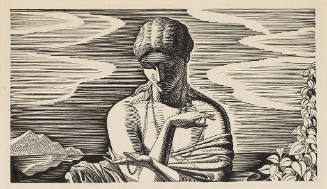
Rockwell Kent
This biography from the Archives of AskART (http://www.askart.com):
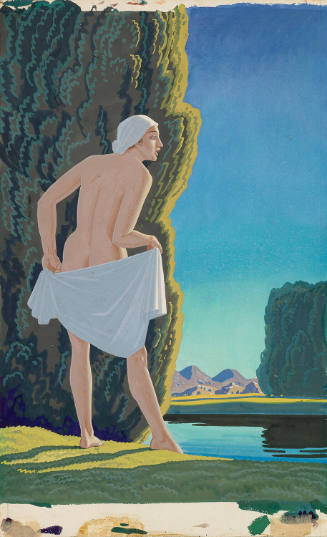
Growing up in a genteel family in New York City, Rockwell Kent was a member of the rugged realist school of landscape painters as well as a popular illustrator and printmaker. His 1930 illustrations for Moby Dick are among his most lasting achievements. He was the first American artist to have work exhibited in the Soviet Union, a reflection of his Communist Party sympathies, which earned him the Lenin Peace Prize in 1967. This espousal of radical politics caused his career to suffer badly in the '50s because his leftist views caused him disdain among many Americans. However, his work, reflecting both realism and modernism, has earned increasing attention from American art historians.
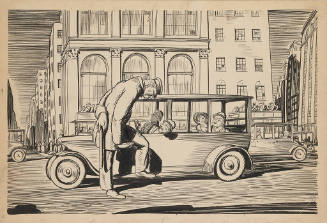
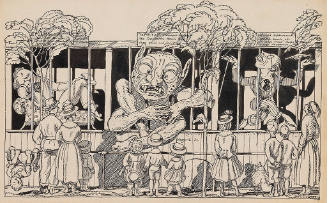
His subject matter is wide-ranging including scenes of Maine's Monhegan Island, the Adirondack Mountains, book illustrations, and commercial art renderings for companies including General Electric, Rolls Royce, and Westinghouse. Although his first love was painting, in addition to illustration, he also did fabric, ceramic, and jewelry designs, and spent time as a dairy farmer, carpenter, home builder, and lobster fisherman.
His father, Rockwell Kent, Sr. was a partner in a prominent New York City law firm and an entrepreneur in Central American mining investments. His mother, Sara Ann Holgate, was the niece and surrogate daughter of James and Josephine Banker, one of New York's first-millionaire families. Young Rockwell's early childhood was divided between Hudson River Valley, Long Island, and New York City homes, each brimming with cultured surroundings and distinguished persons. However, that comfortable life came to an abrupt end in 1887 with the death from typhoid fever of Rockwell Kent, Sr., which left the mother with Rockwell Jr., age 5, and another son, and a daughter who was born shortly after the father's death.
Now in a readjusted circumstance of genteel poverty, Kent was encouraged in his art talent by an aunt, Josie Banker who was a successful ceramic decorator and with whom he traveled in Europe. He studied mechanical drawing and woodworking at the Horace Mann School in New York, and this experience gave him a life-long respect for craftsmanship that is evident in his paintings and drawings.
It was also during these years that he developed his understanding of discrepancies between social classes. He later recalled: "When I was a young fellow, I was very much disturbed by seeing some people with lots of money and lots of people with no money" (Smithsonian, 8/2000 by Scott Ferris).
From 1900-1903, he joined William Merritt Chase's classes at Shinnecock and then entered the New York School of Art studying with Robert Henri and becoming close friends with George Bellows and Edward Hopper. His special mentor, however, was Abbott Thayer with whom he painted in New Hampshire and whose home was a place of wide-ranging discussion about topics including German lieder and Nordic sagas. All of this encouraged Kent to travel extensively. Later Kent married Kathleen Whiting, the niece of Thayer, and they had five children. In 1919, after returning from his Alaskan adventure, Kent decided to move his family out of New York City. Searching for a farm they could afford, Kent and Kathleen, found an isolated property high on the southern spur of Mt. Equinox, near Arlington, Vermont. It was called Egypt Farm. But Vermont was not the Eden-like existence he had envisioned and his infidelities and long absences eventually led to divorce. He was married two other times.
He was an inveterate traveler whose wanderlust created subjects from a wide variety of locations and which caused him to be literally the starving artist, dependent upon outside sources for money. One of his supporters was Duncan Phillips, founder of the Phillips Collection in Washington D.C. who for nine years gave Kent $300. a month in exchange for first selection of two paintings a year.
Much influenced in Ireland by Thayer, Kent's artistic focus became landscape painting and the relationship between nature and humanity. He spent much time on Monhegan Island in Maine, a place he first visited in 1905 at the suggestion of Robert Henri. Although Kent stayed only until 1910, the place became closely associated with his name. Between 1915 and 1935, he visited Newfoundland, Alaska, Tierro del Fuego, France, Ireland, and Greenland. He also wrote designed, and illustrated a number of travelogues.
In 1927, after his marriage to Frances Lee, he settled into a parcel of farmland near Ausable Forks, New York, where he built a studio and felt at home for the first time during his painting career. There he and his wife hosted numerous gatherings of prominent New York people including the Pulitzers, Putnams, and Paul Robeson, Pete Seeger, and John Dos Passos.
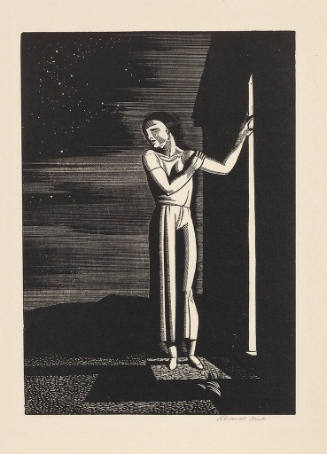
In 1907, his first exhibition was held in New York, and he also exhibited with George Bellows and John Steuart Curry and members of The Eight before 1920. From 1918, he did numerous wood engravings and lithographs, and he left eighty-six paintings and hundreds of drawings, now scattered among museums. In Fall, 1998, the Monhegan Museum held a retrospective of his oil and ink paintings.
Sources:
Much of the above information is from Scott R. Ferris, specialist in the art of Rockwell Kent. He wrote most of the catalog entry for the Sotheby's auction (12/3/03), for the sale of Blue Day and has written the foreword for the reprinted edition of Kent's book, Salamina (Wesleyan University Press. Oct. 2003). On 25 May 2003, "CBS Sunday Morning" aired an article on Kent, and Ferris was interviewed along with Kent's son Gordon, and artist, Jamie Wyeth.
Biography from Hollis Taggart Galleries (Artists, E-O):
Rockwell Kent (1882-1971)
Rockwell Kent was an adventurer. A fascinating individual, Kent had multifaceted careers as an artist, writer, political activist and erstwhile politician, lobster fisherman, ship's carpenter, and dairy farmer. Even within the field of art he practiced multiple mediums including oil and mural painting, watercolor, printmaking, and illustration. He also made pottery and jewelry and designed fabrics, flatware, dinnerware, and greeting cards. His energy was boundless as he explored the world from Alaska to Russia and Greenland to Tierra del Fuego. During his lifetime he was hailed as a talented painter and printmaker and also reviled for his leftist political affiliations. Today Rockwell Kent is regarded as one of America's most versatile and talented artists.
Born in Tarrytown, New York, June 21, 1882, Rockwell Kent was raised in genteel and cultured surroundings in his family's multiple homes in Manhattan, on Long Island, and in the Hudson River Valley. His father, Rockwell Kent, Sr., was a partner in a renowned New York law firm and quite a businessman as well. His mother was a Manhattan socialite from a very wealthy family. In 1887 however, his father died and his mother was left to care for Rockwell and his two siblings. His aunt, a ceramic artist, encouraged young Kent's artistic inclinations and took him on a tour of Europe when he was but thirteen. This experience would profoundly affect the budding artist. His love of adventure books also instilled in him at a young age a thirst for exploits of his own. He was particularly fascinated by Norse and Icelandic mythology, and later in life would be drawn to wintry, northern climes. (1)
Kent was educated mainly in New York. He first attended the Cheshire Academy and then enrolled in the Horace Mann School where he studied mechanical drawing and woodworking and excelled in both. (2) The artist felt his training in mechanical drawing "had a profound effect in conditioning the future direction of his art." Also during this time Kent was enlisted to assist his aunt in painting and selling her ceramic and chinaware, efforts that would help the young artist develop a "strong sense of form, a respect for precise delineation, a love of craftsmanship, and an easy dexterity which remained with him throughout his life." (3) This experience would also prove most useful when Kent designed his own dinnerware later in life.
Before Kent completed his schooling at Horace Mann he began contemplating a career in art. He studied with William Merritt Chase at his Summer School of Art at Shinnecock, Southampton, Long Island. From Chase, Kent learned one of the most enduring lessons of his career, to paint out-of-doors directly in front of nature. (4) Impressed by the young artist's talent, Chase offered Kent a full scholarship to his equally famous New York School of Art. Kent's mother, however, had other plans in mind and convinced him to take the entrance examination for the School of Architecture at Columbia University; he won a four-year scholarship. Toward the end of his college days, however, Kent turned more toward painting and decided to pursue art as his main career. He enrolled in the New York School of Art and continued his artistic training with Robert Henri and Kenneth Hayes Miller. Among his fellow students were George Bellows and Edward Hopper. In addition, he met teacher Abbott Thayer, who hired Kent as a summer assistant at his Dublin, New Hampshire studio in 1903. (5) He would later marry Thayer's niece Kathleen Whiting with whom he had five children.
The artist's famous wanderlust was probably ignited by his first trip abroad and he continued to explore new and often exotic locales throughout his lifetime. His mentor Robert Henri had recommended to him Monhegan Island, off the southern coast of Maine. Kent first went to Monhegan during the summer of 1905 and immediately fell in love with the place and its people. Wishing to stay longer than his meager funds would allow, Kent found himself work as an assistant teamster, longshoreman, and well driller, and remained on the island until December. He would repeat this pattern, spending summers and winters on Monhegan, for the next several years and created some of his most memorable masterpieces during this period. (6) In these, as in most of Kent's landscape paintings, the artist explored the complex relationship between man and nature.
In April 1907 Kent had his first one-person show at the William Clausen Gallery in New York and thereafter exhibited regularly throughout his lifetime in one-person and group shows. (7) Among the dealers who represented Kent's work were Daniel Gallery, the Knoedler Gallery, and the Wildenstein Gallery. (8) In 1911 he helped organize a show for the Society of Beaux Arts Architects in Manhattan, where he met and befriended painter Marsden Hartley. (9) During this period he also came to know Arthur B. Davies and Kent's painting style, and for a time, he reflected the dreamlike, fantasy pictures typical of Davies' work. (10)
In the teens Kent began to find real success as an artist, author, book illustrator, and lecturer. During this decade his adventures took him to Newfoundland from 1914-1915 and Alaska from 1918-1919. Each locale had its unique spirit, which Kent eloquently captured in his paintings and prints, many of which were shown in galleries such as Knoedler in New York. His realistic and somewhat decorative style, and his simplified compositional designs won him favor among artists, critics, and collectors alike. Among his many patrons was Duncan Phillips, founder of The Phillips Collection in Washington, DC, who began acquiring Kent's paintings in 1918. (11)
The 1920s brought new adventures and successes for the artist. He traveled to Tierra del Fuego, Chile in 1922, France in 1925, and Ireland in summer and fall of 1926. Around 1925 Phillips offered financial support to Kent with a stipend of three hundred dollar a month in return for the first selection of two paintings each year. However, the fiercely independent Kent annulled the agreement after about one year. (12) In the late 1920s Kent's life underwent a rather dramatic change. After a divorce from his first wife, Kent remarried to Francis Lee in 1927 and the couple settled on a dairy farm near Au Sable Forks, New York. The couple built a home and studio for Kent on the property, which the artist named Asgaard Farm after the home of the gods of Norse mythology. (13) They also opened a dairy business. Though he spent a great deal of time on the farm, Kent continued to travel. He first visited Greenland in 1929 and was captivated by its rugged beauty. He stayed for two months during his initial trip and returned again in 1931-1932 and in 1934. He later wrote that the year he spent in Greenland was “perhaps the happiest and certainly the most productive of my life.” (14) Kent created dozens of stunning views of the majestic icebergs and mountains of this northern land and portrayed them with humble sympathy for the simple dignity of the natives.
In the 1930s Kent was one of the most renowned painters in America as well as a famous printmaker and illustrator. Among the many books he illustrated were Herman Melville’s Moby Dick: or, The Whale (1930), Chaucer's The Canterbury Tales (1934), Voltaire's Candide (1936), and The Complete Works of Shakespeare (1936). In addition, he made illustrations for his own numerous volumes such as Wilderness: a journal of quiet adventure in Alaska (1920), Voyaging: Southward from the Strait of Magellan (1924), Rockwellkentiana: few words and many pictures (1933), To thee! A toast in celebration of a century of opportunity and accomplishment in America, 1847-1947 (1946), and It’s me, O Lord; the autobiography of Rockwell Kent (1955). During this period he was engaged in commercial work as well for companies like General Electric, Rolls Royce, and Westinghouse. In addition, in 1935 Kent was commissioned by the Federal Public Works Administration to create two murals for the newly built post office in Washington, DC (15).
In the 1940s Kent’s life and career were altered once again. He divorced Frances Lee in 1940 and remarried Sally Johnstone, who was his junior by over thirty years. (16) He traveled far less than he had in the past and in his paintings he concentrated on subjects taken from the area around his beloved Adirondack home Asgaard Farm. He also painted some scenes of Monhegan. (17) In the 1950s Kent's artistic career took a downward turn.
Always interested in politics, Kent believed in the ideals of communism as defined in their broadest terms and was a supporter the International Workers Order, an organization suspected of communist ties. (18) Because of his outspoken approval of the communist system, Kent was the first American to have his work exhibited in the former Soviet Union and he was given the Lenin Peace Prize in 1967. However, his relationship with this extreme leftist ideology also led to his investigation by Senator Joseph McCarthy’s Committee on un-American Activities. As a result, Kent and his art were shunned from galleries and museums across America in the 1950s. In addition, his travel was restricted. In defiance of his homeland’s rejection, Kent gave most of his collection to the former Soviet Union in 1960. (19)
Although discouraged by the lack of support from his fellow Americans, Kent continued to paint until the end of his life. He died of a heart attack March 13, 1971, in Plattsburgh, New York and was buried on Asgaard Farm in view of Whiteface Mountain.
The largest collection of works by Rockwell Kent is located in the Plattsburgh State Art Museum, State University of New York, Plattsburgh. Other works may be found in the following collections: Anchorage Museum of History and Art, Anchorage, Alaska; Alaska State Museum, Juneau, Alaska; Phoenix Art Museum; The University of Arizona Art Museum, Tucson, Arizona; Crocker Art Museum, Sacramento, California; San Diego Museum of Art; Fine Arts Museums of San Francisco, M. H. De Young Museum; Wadsworth Atheneum Museum of Art, Hartford, Connecticut; National Gallery of Art, Washington, DC; National Portrait Gallery, Washington; DC; The Corcoran Gallery of Art, Washington, DC; The Phillips Collection, Washington, DC; Smithsonian American Art Museum, Washington, DC; Delaware Art Museum, Wilmington, Delaware; Art Institute of Chicago; Indianapolis Museum of Art; Mead Art Museum, Amherst College, Massachusetts; Museum of Fine Arts, Boston; Smith College Museum of Art, Northampton, Massachusetts; Worcester Art Museum, Massachusetts; The Baltimore Museum of Art; Colby College Museum of Art, Waterville, Maine; The Nelson-Atkins Museum of Art, Kansas City, Missouri; Adirondack Museum, New York; The Brooklyn Museum of Art; The Metropolitan Museum of Art; Whitney Museum of American Art; The Cleveland Museum of Art, The Columbus Museum of Art, Ohio; Pennsylvania Academy of the Fine Arts, Philadelphia; Philadelphia Museum of Art; Dallas Museum of Art; Tacoma Art Museum; Hermitage Museum, Leningrad, Russia; and the Pushkin Museum of Fine Arts, Moscow, Russia.
Notes
1. Fridolf Johnson, “Rockwell Kent, The Restless,” in An Enkindled Eye, 9.
2. Dan Burne Jones, “Rockwell Kent: Accents on the Positive,” in An Enkindled Eye, 12.
3. Johnson, “Rockwell Kent, The Restless,” 9.
4. Richard V. West, An Enkindled Eye: The Paintings of Rockwell Kent, 15.
5. West, An Enkindled Eye: The Paintings of Rockwell Kent, 16.
6. Johnson, “Rockwell Kent, The Restless,” 10.
7. Virginia Speer Burden, “Rockwell Kent,” in The Eye of Duncan Phillips: A Collection in the Making (Washington, DC, New Haven, and London: Yale University Press, 1999), 367 and West, ‘An Enkindled Eye’: The Paintings of Rockwell Kent, 17.
8. Jones, Rockwell Kent: Accents on the Positive, 12.
9. Burden, Rockwell Kent, 367.
10. West, ‘An Enkindled Eye’: The Paintings of Rockwell Kent,19.
11. Burden, Rockwell Kent, 367.
12. Ibid.
13. West, ‘An Enkindled Eye’: The Paintings of Rockwell Kent, 22.
14. Johnson, “Rockwell Kent, The Restless,” 10.
25. Burden, Rockwell Kent, 367.
16. David Trexel, An American Saga: The Life and Times of Rockwell Kent (New York: Harper & Row, Publishers, 1980), 185-186
17. West, ‘An Enkindled Eye’: The Paintings of Rockwell Kent, 24.
18. Scott Ferris, “The Bestowal,” in Rockwell Kent's Forgotten Landscapes (Camden, Maine: Down East Books, 1998), 74.
19. Ferris, The Bestowal, 74-89.