Henry C. Pitz
Vocations: Painter, Illustrator, Writer, Instructor
Geographic Connection to Pennsylvania: Chestnut Hill, Philadelphia, Philadelphia County; Plymouth Meeting, Montgomery County
Keywords: Arts and Crafts Movement; Army Medical Corps; Pennsylvania Museum School of Art; Howard Pyle
Abstract: Henry Clarence Pitz, a painter and a product of the turn-of-the-century Arts and Crafts Movement, was born in 1895. After attending the Philadelphia Museum School of Art and serving in World War I, Pitz would go on to author and contribute illustrations to various magazines and over 160 books. He has held many memberships, accolades, and teaching positions along with his extensive work in children’s books, histories, and art technique guides. He died in 1976.
Henry Clarence Pitz, born in Philadelphia on June 16, 1895, was the only child of Henry William Pitz (a German immigrant since the 1880s) and Anna Rosina (Stiffel) Pitz. Young Pitz grew up during an artistic revival in fine hand-printed books following a disenfranchisement with the Industrial Revolution’s mass-market production, also known as the Arts and Crafts movement. Pitz developed a drawing talent at an early age, thanks to an interest in the many picture books given to him by his father, a bookbinder. As a child, Pitz admired the work of acclaimed illustrator Howard Pyle and his Robin Hood series for youngsters. He attended the Central Manual School, studying sketching and drafting, taking Saturday morning art lessons, and he took regular academic lessons at the West Philadelphia High School. Shortly before Pitz planned to attend the William Penn Charter School and the University of Pennsylvania’s school of architecture, his father, whose business partner had also been embezzling money from, died unexpectedly.
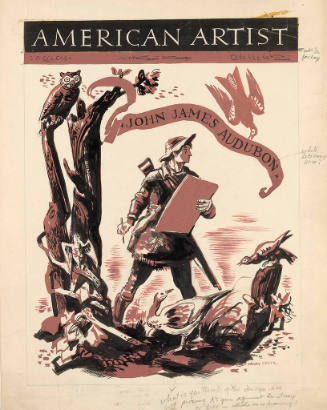
Pitz graduated from primary school in 1914, with a scholarship to the Philadelphia Museum College of Art. He studied there from 1914 to 1918, as well as the Spring Garden Institute in Philadelphia in 1917 and 1920. His education was interrupted when he joined the Army Medical Corps following America’s entry into World War I, wherein Pitz served as an X-ray technician in Allerey, France. He drew many sketches of servicemen and the wartime atmosphere. After the war, he took some of his art samples to New York editors for review, soon receiving his first art commission in Philadelphia illustrating John Bennett’s Master Skylark (1922). In 1929, Henry Pitz published his first book, Early American Costume, a history which filled an important gap in the literature for illustrators and became a valuable reference tool, according to essayist Patricia Likos. Not 10 years after, Pitz began contributing to the magazine American Artist, for which Pitz worked as an associate editor for the next 40 years, writing articles about illustrators, printmakers, advertising artists, and painters, both American and European.
In 1934, Henry Pitz headed the new Department of Pictorial Expression at the Philadelphia Museum College of Art, serving for 26 years and remaining there as a professor emeritus from 1960 to his death in 1976. He married Mary Wheeler Wood in June, 1935, in Chestnut Hill, Philadelphia. With their son Henry William Pitz II and daughter Julia Leaming Pitz Handy Barringer, most of their life would be spent at their home in Plymouth Meeting in Montgomery County.
He held various other positions in academia: an instructor of watercolor art at the Pennsylvania Academy of Fine Arts (1939-1946), visiting critic at Bryn Mawr Art Center (1939), visiting lecturer of fine arts at the University of Pennsylvania (1941) and at the Carnegie Institute of Technology (1964), visiting instructor at the Cleveland Institute, member of board of editors of American Artist Book Club since 1968, a painter of three murals for the Smithsonian Institution exhibit at Chicago World's Fair, an official artist documenting NASA’s Apollo 10 moon launch (May, 1969), visiting lecturer at the University of Utah (1971), and an official artist for the Environmental Protection Agency (1972).
Throughout his life, Henry Pitz authored or illustrated more than 160 books, dealing mostly with children’s books in the 1920s, then moving on with illustrated histories, and finally writing about the history of illustration as well as how-to books for young student artists. He also contributed artwork to various magazines like the Saturday Evening Post, Schribners, Cosmopolitan, Harpers, Century, Country Gentlemen, and Good Housekeeping. Berniece Prisk reviewed Early American Dress, a revised edition of Early American Costume, praising its originality by saying that “The detail in discussing the life of the people gives reason to the kind of clothing worn, an aspect too often omitted in many of the works on historical dress” and that “one becomes absorbed in the life of the people and the variations of dress within a period.” David Kunzle described Pitz’s Howard Pyle in The Art Bulletin: “Pitz faithfully transmits the legacy of [Pyle] ranked by many writers as the first truly great American illustrator,” although “References to Pyle’s stylistic and thematic sources are few, vague, and indiscriminate.” The Brandywine Tradition (1969), perhaps his best-known work of exploring southeast Pennsylvania artists, remained on the bestseller list for 10 weeks.
Henry Pitz’s numerous memberships included: academician of the National Academy of Design, fellowship grant to the Huntington Hartford Foundation near Los Angeles, the Philadelphia Watercolor Club, director of the American Watercolor Society, a lifetime member of the Society of Illustrators in New York, the Newcomen Society, Audubon Artists, the Art Alliance of Philadelphia (vice-president 1938-1961; member of board of directors since 1942), Philadelphia Sketch Club (vice-president 1938-1940; president 1940-1942), director of the Philadelphia Water Color Club, board of trustees member of the Woodmere Art Gallery from 1968, the Philobiblon Club, the Salmagundi Club in New York, the Franklin Inn (a Philadelphia literature club) in 1970, and an honorary doctorate of letters of Ursinus College in 1971.
His many awards included a Bronze Medal from the International Print Exhibition in 1932, Dana Gold Medal from the Pennsylvania Academy of Fine Arts in 1934, Bronze Medal from the Paris International Exhibition in 1938, Hans Obst Prize from the American Watercolor Society Annual in 1952, Obrig Prize from the National Academy in 1953 and 1956, Alumni Gold Medal from the Philadelphia Museum College of Art in 1956, Silver Star Cluster in 1957, the National Academy Prize for Water Color in 1962, Pennational Artists Gold Medal in 1968, and the Philadelphia Athenaeum Literary Award in 1969 for his work The Brandywine Tradition.
The works of Henry Pitz appear in many public places such as the Library of Congress, the Philadelphia Museum of Art, the Cleveland Museum of Art, and the National Gallery of Art. He had participated in art shows at the Pennsylvania Academy of Fine Arts (1930-1969), the American Watercolor Society from (1946-1968), the National Academy of Design from (1950-1972), the National Gallery of Art in 1970, and the Phoenix Art Museum. In 173 Drawings and Illustrations (with Frederick Remington), Pitz spoke of the passing age of fine-art illustration by stating that, “We have fed upon the written word, largely fiction, and the picture, which has become increasingly fictional. The motion picture and the television have implanted persistent images in our minds – images which do not always entirely satisfy and which, more and more, we tend to question.”
Henry Clarence Pitz died at his home in Chestnut Hill, Philadelphia, on November 26, 1976, after working on a painting the day before.
Books:
Early American Costume (with Edward Warwick). New York: Century, 1929. Revised edition Early American Dress: The Colonial and Revolutionary Periods (with Edward Warwick and Alexander Wyckoff). New York: Benjamin Blom, 1965.
A Treasury of American Book Illustration (editor). New York: Watson-Guptill, 1947.
Drawing Trees. New York: Watson-Guptill, 1956. Rev. and enlarged ed. How to Draw Trees. New York: Watson-Guptill, 1972.
Illustrating Children’s Books: History, Technique, Production. New York: Watson-Guptill, 1963.
Drawing Outdoors. New York: Watson-Guptill, 1965.
The Brandywine Tradition. Boston: Houghton Mifflin, 1969.
Charcoal Drawing. New York: Watson-Guptill, 1971.
173 Drawings and Illustrations (with Frederic Remington). New York: Dover, 1972.
Howard Pyle: Writer, Illustrator, Founder of the Brandywine School. New York: C.N. Potter, 1975.
200 Years of American Illustration. New York: Random, 1977.
Illustrated:
One Thousand Poems For Children (with Elizabeth Hough Sechrist and Roger Ingpen). Philadelphia: Macrae-Smith, 1946.
Time to Laugh: Funny Tales from Here and There (with Phyllis R. Fenner, editor). New York: Knopf, 1942.
Sources:
Henry C(larence) Pitz.” Contemporary Authors Online. Gale, 2002. 6 Mar. 2007.
“Henry C. Pitz Dies; Leading Illustrator, Painter and Author.” New York Times 1 Dec. 1976: D23.
Kunzle, David. “Howard Pyle, Writer, Illustrator, Founder of the Brandywine School.” The Art Bulletin 59.4 (Dec. 1977): 649-51.
Likos, Patricia. “Henry Clarence Pitz, 1895-1976, The Art of the Book.” Chadds Ford, PA: Brandywine River Museum, 1988.
Prisk, Berneice. “Early American Dress: The Colonial and Revolutionary Periods.” Educational Theater Journal 18.3 (Oct. 1966): 288-9.
This biography was prepared by Matthew Lavelle.
;The following was written by Mary "Molly" Wheeler Wood Pitz, widow of the artist, Spring 1988
HENRY C. Pitz was the only child of Anna Rosina (nee Steiffel) and Henry William Pitz. His mother's close knit family had emigrated from Lake Constance in southern Germany at mid-century; his father had trained as a bookbinder in Munich, before moving to Philadelphia in the 1880s to open his own bookbindery and leather workshop. Soon after, he met and married Anna, and they set up housekeeping next door to her family at 29th and Poplar streets.
Their son Henry Clarence, born June 16, 1895, demonstrated a talent for drawing. He became an avid fan of Howard Pyle's work, and as a youngster he and a close friend, Walter Kumme, spent considerable time in the studio of Walter's uncle, illustrator Julius Kumme. Although the family planned for their gifted son to attend William Penn Charter School and the school of architecture at the University of Pennsylvania, Henry W. Pitz died unexpectedly and his business partner embezzled money from the firm. This forced Anna Pitz to make other plans for young Henry's education.
She sent him to local schools, one of which was Central Manual School, and enrolled him in art lessons on Saturday mornings. In 1914 he was graduated from West Philadelphia High School, winning both a history prize and a scholarship to the Philadelphia Museum School of Industrial Art at Broad and Pine streets.
At the museum school Henry began studying with former Pyle student Thornton Oakley and subsequently with other Pyle students-Walter Everett, Maurice Bower, Harvey Dunn, and George Harding, all of whom lectured at the Pennsylvania Academy of the Fine Arts as well. He also met the famous women students of Pyle's Chadds Ford and Wilmington studios: Violet Oakley, Jessie Wilcox Smith, Charlotte Harding, and Elizabeth Shippen Green.
When not in classes Henry took every opportunity to attend theatre, ballet, concerts, lectures, and exhibits. But World War I interfered. In 1917, his last year at the art school, he enlisted in the Army Medical Corps as an X-ray technician assigned to Base Camp 56, Allerey, France, assisting Colonel Coates, a Philadelphia surgeon, in the operating room. He also continued to sketch in his spare time. Following the armistice in November 1918, he accompanied Colonel Coates and Captain Sheldon on an inspection tour of Luxembourg and Alsace-Lorraine and filled a sketchbook with pictures of the ravages of war.
Returning to Philadelphia unscathed and anxious to commence his career, Henry initially taught other veterans at the school he had left a few years earlier. In 1920, he showed his portfolio to art editors of several New York publishing houses and came back to Philadelphia with a commission to illustrate John Bennett's Master Skylark. This was the first of more than 250 projects he undertook during the next five decades.
A new facet of his career opened in 1928. Century Company invited Henry and Edward Warwick to both write and illustrate a book. The book, "Early American Costume", filled an important gap in the literature for illustrators and became a valuable reference tool that is still used today. That was the first of eighteen books that Henry wrote. Most of the others were "how-to" books aimed at the art students, such as The Practice of Illustration, Drawing Trees, Pen, Brush and Ink, How to Use the Figure, A Treasury of American Book Illustration, and Illustrating Children's Books, but among the later ones were broadly interpretive essays that drew on his breadth of experience and wealth of information, such as The Brandywine Tradition.
Less than a decade after writing his first book, Henry joined American Artist, a monthly magazine published in New York under the guidance of editors Arthur Guptill and Ernest Watson, and later Norman Kent and Susan Meyer. As an associate editor and writer, during the next forty years Henry contributed numerous articles about illustrators, printmakers, advertising artists, and painters - American and European.
Yet another aspect of Henry's career was teaching. In 1934, Edward Warwick, then Dean at the museum school, asked Henry to head the newly formed Department of Pictorial Expression. Henry accepted. For twenty-six years he trained, inspired, and encouraged many of the finest illustrators of the day, including Joseph and Beth Krush, Helen and William Hamilton, Sidney Goodman, Edward Smith, Albert Gold, Howard Womer, Edward Michener, Fred de p. Rothermel, Ranulph Bye, Isa Barnett, Paul Keene, Jacob Landau, and Howard Watson.
His colleagues were a host of talented artists-Earle Horter, John Lear, Ben Eisenstat, John Geiszel, Edward Shenton, Ben Solowey, and William Emerton Heitland-and distinguished artists, publishers and editors whom Henry and fellow faculty members invited to lecture. These years were exciting and stimulating for illustrators and rivaled the turn-of-the-century spirit of Howard Pyle's school. Henry's long standing admiration for Pyle served him well; artistically he was a self-conscious descendent of that vital group.
An active and committed artist, Henry belonged to the Philadelphia Sketch Club, the Philadelphia Watercolor Club, the Art Alliance of Philadelphia, in addition to the Salmagundi and Society of Illustrators in New York. In 1950 he was elected to the National Academy of Design. He exhibited widely, for which he won many prizes for his watercolors, prints, drawings, and illustrations, and willingly served as a frequent juror for art exhibitions.
By the 1960s Henry had demonstrated considerable insight in his studies of the art and artists of the Philadelphia and Brandywine regions. His enduring interest in the Wyeths, led Lovell Thompson, then editor-in-chief at Houghton, Mifflin and Company in Boston, to commission him to write The Brandywine Tradition, published in 1969. The book remained on the best seller list a remarkable ten weeks because it struck a responsive cord with a public that was appreciative of the worth and vitality of native talent. Three years later Clarkson Potter, Inc., a New York Publishing house, commissioned him to write Howard Pyle: Writer, Illustrator, Founder of the Brandywine Tradition which was published in 1975.
Honors followed honors. Henry was granted a fellowship at the Huntington Hartford Foundation near Los Angeles. The National Aeronautics and Space Administration asked him to be one of the artists who recorded the Apollo launch to the moon from Cape Canaveral, Florida, in May 1969. The following year Henry was invited to join the Franklin Inn, an old, distinguished literary club in Philadelphia whose members were and are leaders in the fields of education, journalism, and the arts and sciences. He accepted with pleasure and lunched there on the days he taught at the art school-by then called the Philadelphia College of Art. The following year, 1971, Ursinus College conferred a Doctorate of Letters on him and the Philadelphia Athenaeum awarded him a prize for The Brandywine Tradition.
In 1935, Henry had married Molly Wood in Chestnut Hill. During most of their married life they lived in Plymouth Meeting, where they raised two children, Juha Leaming Pitz Handy Barringer and Henry William Pitz II. Henry and Molly enjoyed forty-one years of a rich and varied life filled with pictures, books, music, friends, family, and travel, both abroad and in the western United States. Henry's last year of life was busy with two one-man shows, and writing the text for 200 Years of American Illustration. He was working on a painting the day before he died in his eighty first year, November 26, 1976, revered and beloved by his many friends and family.
Henry Clarence Pitz, born in Philadelphia on June 16, 1895, was the only child of Henry William Pitz (a German immigrant since the 1880s) and Anna Rosina (Stiffel) Pitz