

Island Funeral
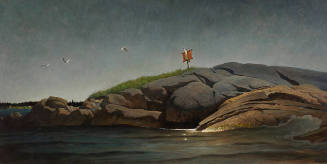
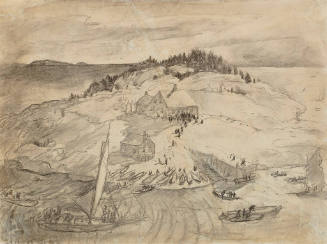
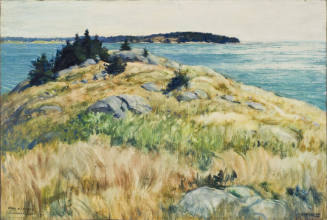
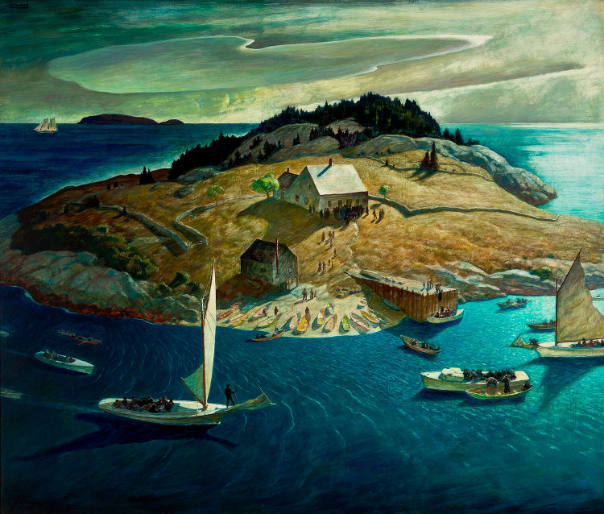
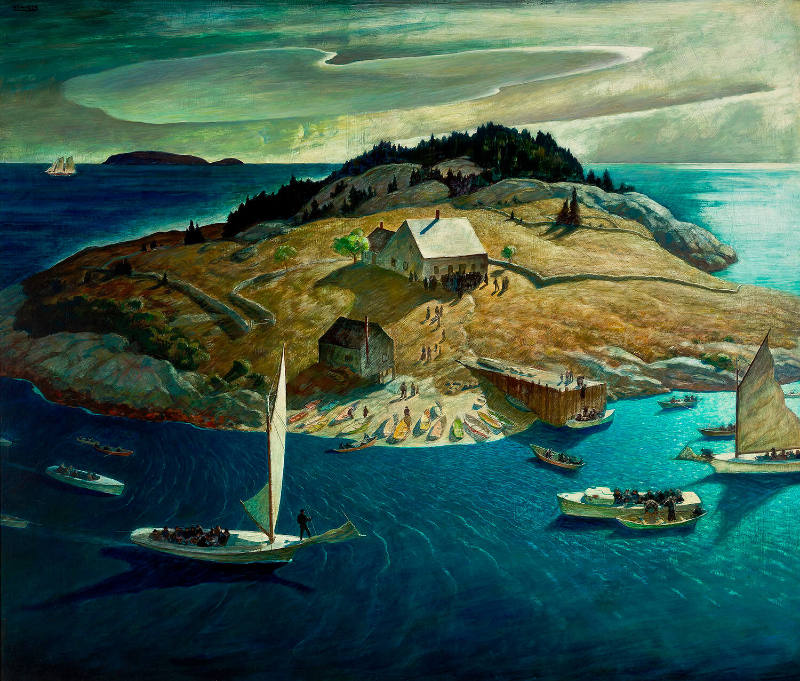
Island Funeral was inspired by the funeral of Rufus Washington Teel, a Maine fisherman, who died on September 11, 1934. Teel was born, lived and died on Teel Island, about a mile off shore from the village of Port Clyde where the Wyeths had a summer home. No members of the Wyeth family attended the funeral, but Ann Wyeth McCoy remembered that the family sat on the porch of Eight Bells, their home, and watched the boats pass on the way to and from the funeral. The artist must have considered the idea for the picture for some time; Andrew Wyeth believes his father started the painting in 1935, and he worked on it intermittently until 1939 in his Chadds Ford studio. Wyeth successfully combined aspects of a modernist style with a composition that recalls the late 19th and early 20th century bird’s-eye views.
One of the most striking features of the painting is the intensity of the blues and greens Wyeth used, the result of an informal collaboration with the DuPont Company. Chemists employed at the company's Jackson Laboratory provided Wyeth with pigments made from "Monastral Fast Blue B" and "Monastral Fast Green G," two vibrant, light-fast dyes that had been recently developed at DuPont.
Island Funeral was the centerpiece of Wyeth’s first and only one-artist gallery exhibition at New York’s Macbeth Gallery. The exhibition’s purpose was to present Wyeth as an artist rather than an illustrator. All his life, he struggled to shed the pejorative connotations associated with illustration, and more than any other painting, the multi-layered Island Funeral demonstrates his consummate artistry of composition, color, and expression. Island Funeral shows that Wyeth overcame that designation of "illustrator" and earned his place in the history of American art.