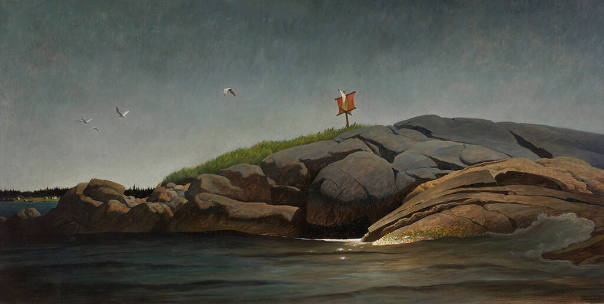
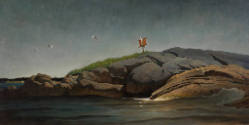
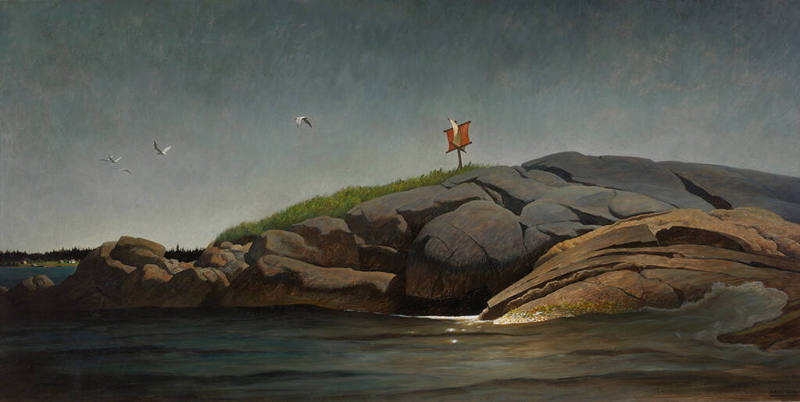
Blubber Island, Port Clyde, Maine
- Hydrographic Signal, Blubber Island; Hydrographic Signal
Wyeth and his son Andrew were introduced to the techniques of tempera painting by Peter Hurd, who, in 1929, had married N. C.’s daughter Henriette. Unlike Andrew, however, who embraced the medium, N. C. Wyeth ultimately found that the practice did not suit his artistic temperament; in approximately half of the two dozen "tempera" paintings he completed between 1935 and 1945, he probably also incorporated oil-based pigments. Analysis has confirmed the presence of oil paint on this panel.
"Eight Bells," Wyeth’s summer home in Port Clyde, Maine, lies just outside of the left edge of the painting. The hydrographic signal marker seen here was a reference to the U.S. Department of Commerce's Coast and Geodetic Survey, a program that compiled and revised nautical charts. Silhouetted against the sky, the billowing fabric of the man-made marker contrasts with the island’s rugged and rocky shoreline. The spare composition, the artist’s precise style, and his rendering of the distinctive quality of Maine light give the painting a compelling clarity.