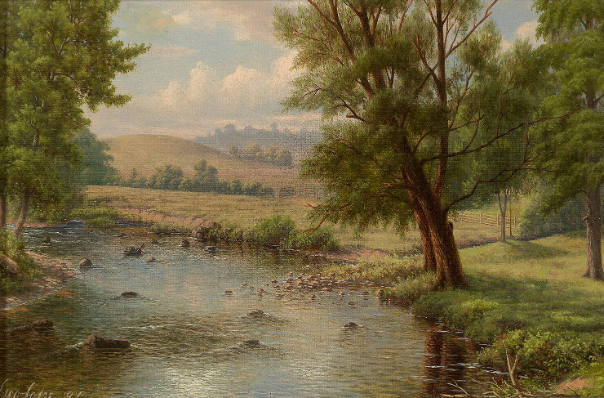
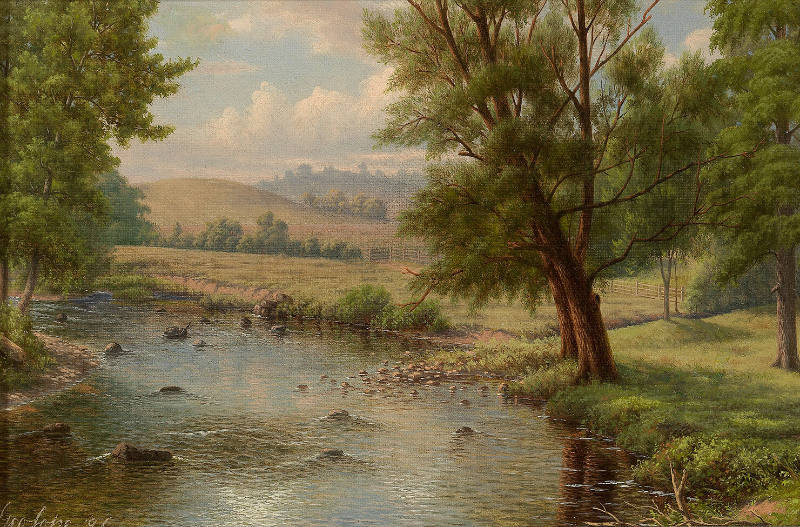
Pyle's Ford
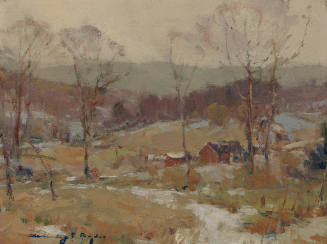
George Cope was born in 1855 near West Chester, Pennsylvania, and spent most of his life in the Chester County area. He originally trained with German landscape artist, Hermann Herzog, who lived in Philadelphia and was known for painting intimate and bucolic landscape scenes. Cope also produced landscapes in this style, and many of his scenes are set in the Chester County countryside.
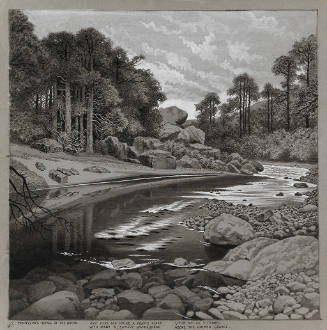
An example of such a landscape is this view of Pyle’s Ford, which is located at a narrow stretch of the Brandywine River near the Pennsylvania and Delaware state line. A ford is a shallow area of a river, making it ideal for crossing, and Pyle’s Ford carries historical significance from the Battle of Brandywine, a major battle of the Revolutionary War. General George Washington posted militia there, and at nearby Chadd’s Ford and Brinton’s Ford, in order to hold off a British advance toward Philadelphia, which was the nation’s capital at the time. However, on September 11, 1777, the British army of General Sir William Howe defeated the Continental Army by outmaneuvering them. Some of Howe’s soldiers crossed at Chadd’s Ford, but the bulk of his troops crossed the Brandywine River farther north than expected, at Jeffries’ Ford, allowing them to attack Washington’s army from both the left and right flanks, thus defeating them. This battle, in addition to subsequent maneuvers by the British Army, left Philadelphia vulnerable, and two weeks later, the British captured the city, which it would occupy for nine months.
While Cope painted many of his landscapes in his studio after making sketches on site, he would sometimes work en plein air, or outdoors, at the site, where he painted directly onto the canvas.