Spring--1918
- Spring, 1918; The Letter; The Letter--1918
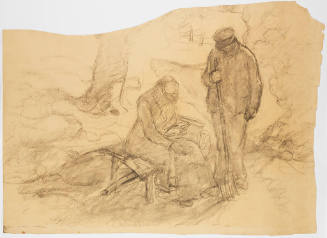
Spring—1918 imagines N.C. Wyeth’s parents in Needham, Massachusetts, during World War I. By 1932, both Henriette Zirngiebel Wyeth and Andrew Newell Wyeth had died. In the painting, Wyeth freely associated his father with the French peasantry, depicting him in a blue jacket and cap typical of a French farmer and evoking the figure in Millet’s The Angelus, a painting Wyeth much admired. The figure of his mother sits reading a letter, presumably from the front, with folded newspapers, another source of information, beside her. The work represents a tribute to what the artist saw as his mother’s strength and courage during World War I when two of her sons served overseas, and to her expressed disappointment, her eldest, N. C. Wyeth, had declined several offers to become an official Army artist. The mood of the painting is heightened by the twisted limbs, barren field and smoky fire, tinging it with nostalgia, regret and sorrow. While the painting is extremely personal to the artist, the subject struck a chord with anyone who had waited at home for news from abroad.
In 1944, during World War II, Wyeth painted the composition again, with only slight modifications, using tempera on hardboard panel. He titled this version The War Letter, which immediately imbued the work with new and heartrending meaning.