The Artist
Maxfield Parrish’s highly popular images for books, magazines, posters, and fine art reproductions are often a unique blend of reality and fantasy. His mature work incorporates precision of line, well-placed pattern and ornament, mathematically based compositions, photographic images, and the oil-glaze painting methods of the Italian Renaissance. Such inventive application of antique and modern techniques reflects Parrish’s approach to art as craft.
In 1904 the artist signed an exclusive six-year contract with Collier’s to illustrate the magazine’s large-format covers. This arrangement afforded Parrish better color reproduction of his work and greater freedom in design. Many of his bold graphic works for the magazine foreshadow the Op Art work of the 1960s.
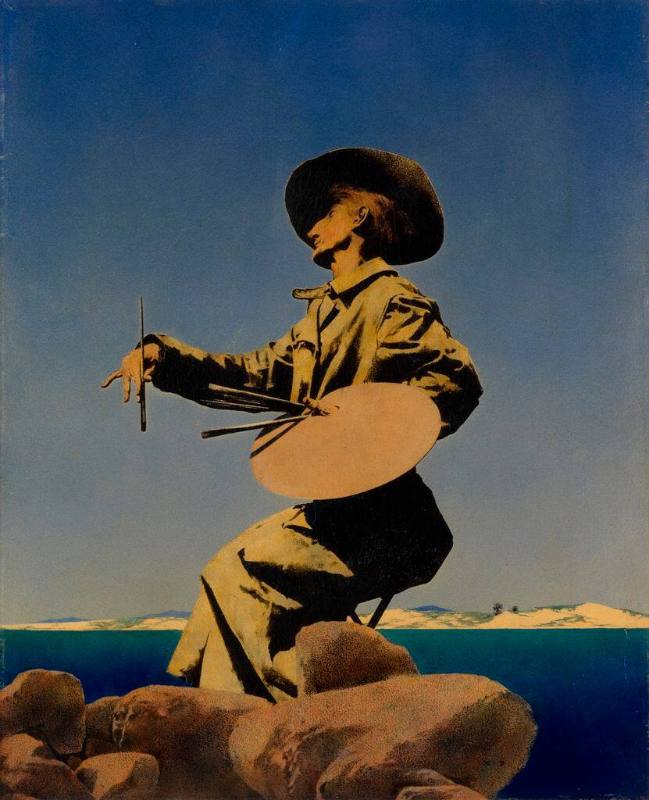
"The Artist" was one of the last in the Collier’s cover series. The final painting is a montage of Parrish’s photographs of rocks, landscapes, and his own image posed for the central figure. Sketched on stretched paper, the composition was then painted in layers of thin, luminescent oil glazes. The artist eliminated unnecessary details, emphasized light and shadow, and rendered texture by stippling on tiny dots of color, marking with his fingerprints, and scratching with a fine tool. He represents himself as a common stereotype of an artist—an overly refined aesthete, both effete and disconnected from the land he represents in the background. This artist, it seems, is merely posturing, literally; he poses with palette and brushes, but has no easel or canvas before him to do the work of an artist.