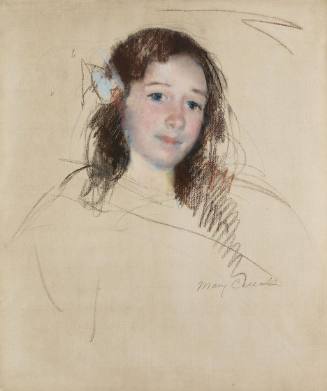
Mary Cassatt
Mary Cassatt (American, 1844-1926)
Mary Cassatt was the only American artist officially associated with the French Impressionists. Talented, dedicated and independent in spirit, Cassett drew widespread critical acclaim for her penetrating studies of modern women and her fresh, spontaneous renderings of mothers and children. Cassatt also played an important role as an advisor to such American collectors as Mrs. Porter Palmer and Louise and Horace Havenmeyer, urging them to purchase art by both Old Masters and the French avant-garde.
Born in Allegheny City, Pennsylvania, near Pittsburgh, Cassatt began her art instruction at the Pennsylvania Academy of the Fine Arts, where she studied from 1861 to 1865. In 1866 she went to Paris, studying in the ateliers of Charles Chaplin and Jean-Léon Gérome. On later trips to Italy, Spain, Belgium and Holland, she studied and copied the works of Correggio, Parmigianino, Hals, Velasquez, and Rubens.
Cassatt began exhibiting at the Paris Salon in 1868. Her early work was dark and somber in tone. However, as her dissatisfaction with traditional academic art increased, she soon developed a more painterly, colorist approach, inspired by the new realism of such painters as Edgar Degas and Edouard Manet. At the Salon of 1874, Cassatt’s painting Ida attracted the attention of Degas, who would become her friend and chief mentor. She was subsequently invited to join the Impressionists (then known as the Independents), and exhibited with them in 1879, 1880, 1881, and 1886.
In addition to her depiction of mothers and children, Cassatt produced numerous images of small girls and boys. Her earlier such compositions were mostly commissioned portraits or more informal portrayals of her various nieces and nephews. However, sometime after 1900, she began a series of portraits of young children, residents of the village near Cassatt’s summer home, the Chateaux Beaufresne at Menil-Théribus, Oise. Although she sometimes depicted boys, Cassatt’s favorite and most popular subjects were young girls of about five to six years of age.
On numerous of Mary Cassatt’s drawings one finds the so-called Mathilde X stamp. Mathilde Valet was Cassatt’s servant during the last years of the artist’s life. By 1923, Ms. Valet had assumed complete responsibility of Cassatt’s housekeeping, including her many drawings and papers. Eventually, thirteen years after Mary Cassatt’s death (in 1939), these works on paper were marked Mathilde X and, with little public recognition, put to auction.
Pertinent Literature:
Forthcoming revision of Adelyn D. Breeskin’s catalogue raisonné of the artist’s work, being prepared by the Cassatt Committee
Breeskin, A.D. Mary Cassatt: A Catalogue Raisonné of the Oils, Pastels, Watercolors and Drawings, Washington, D.C. 1970
[Taken from internet web site of Comenos Fine Arts, www.comenosfinearts.com, 2/7/2000 --jag]