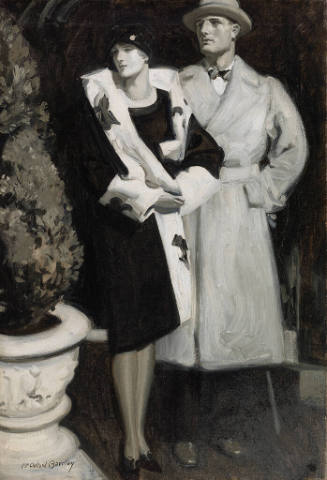
McClelland Barclay
From Askart.com accessed 12/19/2017 (http://www.askart.com/artist_bio/McClelland_Barclay/28166/McClelland_Barclay.aspx):
"Barclay was born in St. Louis, Missouri in 1891 and worked out of a studio in New York City, beginning in 1912.
Visible and patriotic, he served in the Navy in World War I. He created a memorable series of posters for the Red Cross, the military and other service organizations, receiving commendations and awards. He also designed Republican posters, and even managed to sneak pretty girls into those.
Barclay's work was in great demand and he produced covers and illustrations for almost all of the popular magazines of the 1920s and 30s, including COLLIERS, PICTORIAL REVIEW, COUNTRY LIFE, LADIES HOME JOURNAL, SATURDAY EVENING POST, REDBOOK, COUNTRY GENTLEMAN, COSMOPOLITAN, and others.
His most famous advertising campaign was for the Fisher Body Works. He began to produce illustrations for this series in the mid 1920s and it ran successfully through the 1930s. The first ads featured children and dogs; the famous Fisher body Girl was introduced by Barclay in 1930 when he was 37. The model was his second wife, who was only 19 at the time.
The Fisher Body Girl became as recognizable a fixture as the earlier "Gibson Girl", but alas, the Barclay's marriage did not last as long as the campaign. In 1933, Mrs. Barclay had fallen by the wayside, and in 1936, McClelland had picked up a new fiancé, model Virginia Moore who was only 22.
In the late 1930s, Barclay established the McClelland Barclay Art Products Corporation in order to produce utilitarian composite figures on a large scale. These items included individual standing animal figures, ashtrays adorned with dogs or horses, bookends, boxes and other articles for home and office use. Made of white metal coated with a thick bronze plate, they were signed with the artist's name and sometimes with other marks or copyright designations. Advertising for Barclay's small bronze dog figures were seen as early as 1930 which suggests that his attempts at commercial sculpture predate the formation of his company. In 1938, 3 inch figures could be purchased for as little as $5.00!
In 1941, Barclay returned to military service in the Navy as a procurement and recruiting officer, moving eventually to a division where his artistic talents could be better utilized the War Arts Corp. Working steadily, he recorded the war around him, the people, and other aspects of his daily existence in the Pacific. Some of these canvases were produced for promotional purposes, while others were personal or commissioned works.
"On July 23, 1943, Lt. Commander McClelland Barclay was reported missing in action aboard an LST that was torpedoed in the Solomon Sea," notes Donna Newton in her publication, THE SCOTTIE SAMPLER, Summer, 1986. "He was honored posthumously with the Purple Heart in 1944 and on the third anniversary of his death, the McClelland Barclay Fund for Art was established to aid American artists."
With the passing of McClelland Barclay, the art world lost a colorful, talented, restless character. Barclay figures have been reproduced by others, so take care to inspect anything you anticipate buying, as originals bear the artist's signature on the underside.
Source:
Michael Taylor"