Harrison Cady
Biography from Charleston Renaissance Gallery:
WALTER HARRISON CADY (1877-1970)
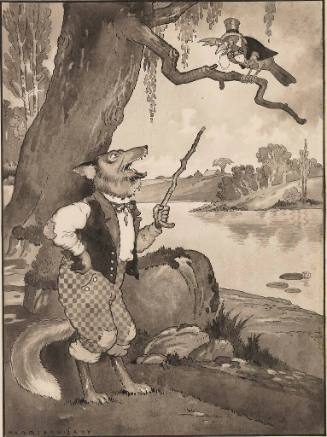
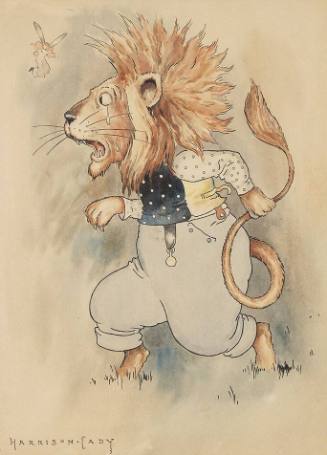
Best known for his illustrations of Peter Rabbit, a character invented in the 1920s by Thurmond Burgess, Harrison Cady began drawing and sketching as a child in Gardner, Massachusetts, and enjoyed a long and successful career in New York City as a magazine and book illustrator. In 1925 he purchased a harbor-front estate at Rockport, Massachusetts, and turned his attention to oil painting. He exhibited landscapes and marines with success at the National Academy of Design in New York, had solo exhibitions at the Macbeth Gallery, showed at the New York World’s Fair in 1939, and at Kennedy and Company until 1949.
From the late 1920s through the 1950s Cady sought out picturesque scenery that “seemed on the verge of being swept away by modernity,” (Moffatt, 1985, p. 6), and recorded the faded elegance of such historic sites as Beaufort and Charleston, South Carolina; Savannah, Georgia; and New Orleans. He was also attracted to mountain scenery, and made frequent trips to North Carolina, West Virginia and Virginia, especially during the 1930s when interest in Appalachian subjects was high. Though he rarely dated or documented his work, A Walk in the Village was probably painted in the mid-1930s, during one of his visits to Ashville.
Cady was especially fond of the nearby towns of Burnsville and Spruce Pine. The houses were historic and picturesque; the lawns manicured; the streets dotted with ancient oaks and pines. The rich color of his palette, and the romantic mood of his compositions assured his popularity.
Cady’s Southern genre was exhibited at the Salmagundi Club’s Spring Exhibition in 1950. He was given his last one-man show by the Fitchburg [Massachusetts] Art Museum as late as 1964. NRShaw
Moffatt, Dr. Frederick C. Harrison Cady: The Southern Image. University of Tennessee, Knoxville, 1985.
Biography from Carolina Galleries - Southern Art:
Walter Harrison Cady
1877-1970
Walter Harrison Cady was born in 1877 in Gardner, MA. Primarily a magazine and book illustrator, his work was published in LIFE, the Saturday Evening Post, Country Gentleman, and the Ladies Home Journal. Cady's etchings were included in Fine Prints of the Year (1930) and are in the collections of The Library of Congress. He was a member of the American Society of Etchers and the American Watercolor Society. He also exhibited at the National Academy. He died in 1970.
Biography from AskART:
Harrison Cady was a noted illustrator, born in Gardner, Massachusetts and best known for his works in Bedtime Stories, a daily-newspaper created by book and magazine writer Thornton W. Burgess. Burgess conceived the character of Peter Rabbit (not to be confused with Beatrix Potters creation of the same name), and each of these Bedtime Stories was illustrated with a drawing by Cady, who had illustrated some of Burgess magazine stories as early as 1911.
Cady started his art career in the last years of the nineteenth century. He was better noted at the time for his work in books and magazines and for his gag cartoons. He also did work as a comic-strip artist, having begun working in that field for the Philadelphia Press starting in 1905. His first Peter Rabbit newspaper comic feature page appeared on Sunday, August 15, 1920, in the Tribune, and was later distributed nationally by the New York Herald-Tribune Syndicate. Despite repeated demands from readers, there never was a Peter Rabbit daily strip.
In addition to drawing the feature, Cady also wrote the story lines. At first, he stuck close to Burgess rustic locales of Green Meadows and Smiling Pool, but he later transferred his bunny hero to the suburban setting of Carrotville, and devised stories of his own. A portly, middle-aged white rabbit of dignified mien, Peter lived in the company of his chubby wife Hepsy and his two mischievous sons (one or both of who were indifferently called Peter Jr. or Petey). He was apparently a rabbit of means: he drove a car, had a large wardrobe, belonged to a country club, and engaged the services of a maid named Bridget Possum.
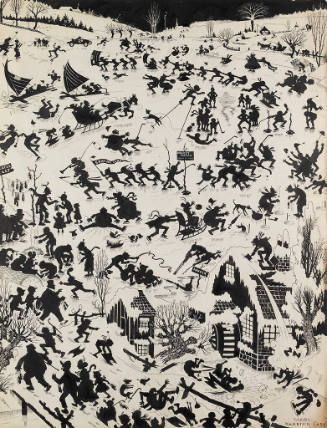
Peter and his offspring always pursued some innocent activity that quickly turned into full-scale disaster. Peter would knock down an entire row of houses with his car, or bean a number of players with one golf ball, or his sons would blow up their classroom in one of their science experiments. These accidents would inevitably end up with a lynch mob hot on the culprits heels, brandishing canes, cudgels, baseball bats, and hockey sticks, and screaming imprecations like "After im, boys," "Well fix im," and "Get th villain." Peter and his kids would then make mile-a-minute tracks back to their house, which they would barricade against the enraged citizenry.
With the exception of World War II, which was hard to ignore, Cady seldom let events from the outside would intrude on the goings-on around Carrotville and its surroundings. A staunch conservative, he would, however, take oblique swipes at the Roosevelt administration in the 1930s. This aspect of the strip did not go unnoticed by Coulton Waugh, who wrote in 1947, "Peter himself may be a rabbit, but more precisely he is one of the earliest comic business fathers, an exceedingly Republican rabbit forced out to make needless reports on his business."
Cady drew Peter Rabbit in a more concise version of his minutely detailed style. The drawings were eye-pleasing, and the frenzied action was rendered with tongue-in-cheek naturalness. The anecdotes, however, were repetitious and were criticized as becoming cloying after a while. Cady retired at age 70, in 1948 (his last page appeared on July 25). Vincent Fago, a former Max Fleischer animator, succeeded him with somewhat disastrous results. Fago tried to remake Peter into a Bugs Bunny clone, but his efforts were critiqued for limp drawings and stale jokes. The feature, which declined to being carried almost exclusively by the lonely Herald-Tribune, managed to last until March 11, 1956.
(Information for the biography above is based on writings from the book, 100 Years of American Newspaper Comics, an illustrated encyclopedia edited by Maurice Horn.)