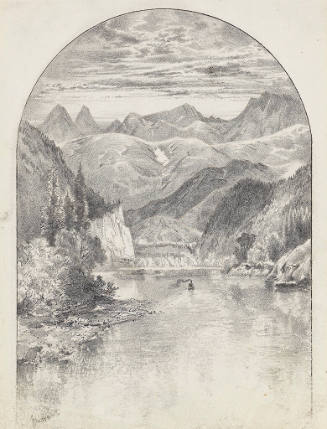
Thomas Moran
This biography was submitted by Thomas Nygard Gallery
Thomas Moran immigrated to America from England with his family as a child. Though he received no formal art training, he was an apprentice to a wood engraver in Philadelphia during his teens. From his experience, he learned the skillful manipulation of texture and value (light and dark), that became so evident in his works.
Moran became a western artist after working as an illustrator for magazines including "Harper's" and "Scribner's". At the age of thirty-four, he was invited to accompany Ferdinand V. Hayden's 1871 Geological Survey Expedition to "the Yellow Stone Territory." Also traveling with the Hayden Expedition was pioneer photographer William Henry Jackson, with whom Moran forged a life-long friendship and collaborated on many artistic projects. Moran's paintings of Yellowstone's geysers, hot springs canyons, and cliffs, combined with Jackson's remarkable photos, played a major role in convincing Congress to make the region a national park in 1872.
After the Yellowstone trip, Moran's career as an expedition artist and painter blossomed. He continued to travel with subsequent Hayden surveys, and painted Yellowstone, Yosemite, and the Grand Canyon as well as other wilderness regions for the next forty years.
In all his works Moran strived to recreate nature colorfully, vibrantly, and idealistically, while at the same time evoking the viewer's strong emotional response. He used many media to achieve his artistic goals and created thousands of oil paintings, watercolors, drawings, and chromolithographs during his long life.
This biography was submitted by Drummond Gallery
Thomas Moran, NA (1837-1926) was born in Bolton, England, and came to the United States whan he was seven years old. He was one of seven children, and three of his brothers, Edward, John and Peter, also became famous artists.
Largely self-taught, Moran worked in his youth for a wood engraver in Philadelphia, then shared a studio with his brother Edward.He experimented with pencil, charcoal, ink, wash drawings, wood engraving, watercolor and oil. He went to Europe with his wife, Mary Nimmo, and studied the work of J.M.W. Turner and came under the influence of the old masters.
His first opportunity to travel in the West came when he joined a Geological Survey Expedition to the Yellowstone territory in 1871. On this trip he befriended William Henry Jackson, the pioneer photographer, and through Jackson's photographs and Moran's paintings of the Yellowstone area, Congress was influenced to declare it a national park. Many times after this expedition, Moran traveled throughout Colorado, Wyoming, Arizona, Utah and Old Mexico painting their scenic grandeurs.
His enormous panorama, "The Grand Canyon of the Yellowstone," one of his many variations on the subject, hung in the national Capitol building for many years, as did another massive painting, "The Chasm of the Colorado." Both were purchased by Congress at ten-thousand dollars each.
Later in his career Moran visited New Mexico and became interested in painting the Indians and their surroundings near Acoma and Laguna. But his most lasting fame will probably rest on his vivid and dramatic scenes of Western America's many national parks and monuments.
He continued to paint well into an advanced age, and died in Santa Barbara, California at eighty-nine.
This biography was submitted by Altermann Galleries
Born in Bolton, Lancaster, in England, Thomas Moran was a painter and printmaker. His brothers, Edward, John and Peter were also artists, and he himself actually studied under Edward. In the mid 1800’s, the Moran family emigrated from England, and in 1844 settled in Philadelphia, where Thomas began his career as an illustrator.
Between the ages of 16 and 19, Moran was apprenticed to the Philadelphia wood engraving firm, Scattergood & Telfer. He then began to paint more seriously in watercolor and expanded his work as an illustrator. His brother Edward, who was an associate of James Hamilton, the successful marine painter, guided, encouraged and helped Moran during this time.
In the 1860’s, Moran produced lithographs of the landscapes around the Great Lakes. While in London in 1862, the first of many return trips to the land of his birth, Moran was introduced to the work of J.M.W. Turner, which remained a vital influence on him throughout his career.
With his wife, Mary Nimmo Moran, who was also an etcher and landscape painter, Moran participated in the Etching Revival, scraping fresh and romantic landscapes and reproductive etchings, such as "Conway Castle, after J.M.W. Turner" which was done in 1879.
During the 1870’s and 1880’s, Moran’s designs for wood-engraved illustrations appeared in most of the major magazines of the time, as well as gift books, which greatly added to his success and popularity.
Reference: www.artnet.com
This biography was submitted by William A. Karges Fine Art - Los Angeles
Thomas Moran was born in Lancashire, England, and, with his family, moved to the U.S. in 1844. Inspired to paint by his older brother, Moran studied privately in Philadelphia before returning to England for further study. While abroad, Moran was influenced by the hugely successful J.M.W. Turner, and Moran set about copying the master’s moody, atmospheric works.
Returning to the U.S., Moran made painting expeditions to the monuments of the American West, first to Yellowstone, then continuing to the Grand Canyon and Yosemite. The finely executed panoramas from these treks won Moran tremendous acclaim that would stay with him for the rest of his life.
Escaping the harsh winters, Moran moved to Santa Barbara in 1922, where he died four years later.
--------------------------------------------------------------------------------
This biography from the archives of AskART.com.
Regarded as the primary artist of the final decades of Western exploration, Thomas Moran made eight trips West between 1871 and 1892 and created a body of oil and watercolor sketches that remain a primary record of that period. In fact, his painting was so associated with the West that he was referred to as T. Yellowstone Moran. In 1873, he began signing his name with a monogram that incorporated "Y" into his initials, and from 1911, he added a thumbprint.
He was born in Bolton, Lancashire, England, and his father was a hand-loom weaver. In 1844, his family emigrated to Philadelphia where in 1853, he apprenticed to a wood engraving firm and sketched designs on blocks. He also studied with his older brother, Edward, a marine and historical painter, whose studio he shared.
In 1860, he made his first trip heading west, going to Lake Superior. Shortly after, he and Edward went to England where both brothers were heavily influenced by copying paintings of landscapist J.M.W. Turner. In 1866 and 1867, he returned to Europe and studied the tonalist painting style of Corot and did studies of Venice.
In 1871 at age 34, he began the subject matter that challenged him for the remainder of his life. He traveled West with geologist F.V. Hayden on the Hayden Survey to the Grand Canyon and the Yellowstone River. Returning he moved his studio to Newark, New Jersey, and began doing huge panoramic paintings from his sketches.
In 1872, he sketched in Yosemite and other parts of California, and in 1873, explored the Grand Canyon with Major Powell's survey team. The United States Congress bought two paintings from these trips for $10,000 each. From 1881 to 1911, he traveled nearly every year, often in the West, and also painted in Florida and Europe.
In 1916, he settled in Santa Barbara, California where he died in 1926, having spent the later part of his life painting from sketches he made from earlier travels. His popularity never declined, and he was an active artist well into his 80s. By the time of his death, many of his favorite painting areas were protected in national park land.
Although he is credited as a great documentary painter, he did not intend his paintings to be literal records of what he saw. He was committed to mysticism, a personal spiritual vision that caused him to find inspiration in nature. He said: "All my tendencies are toward idealization. A place as a place has no value in itself for the artist" (Samuels "Encyclopedia"). On his deathbed, at age 90, he envisioned on his ceiling future landscapes to paint and expressed ongoing disapproval of modernist, abstract art.
Credit:
Matthew Baigell, "Dictionary of American Art"
--------------------------------------------------------------------------------
This biography was submitted by Nedra Matteucci Galleries
THOMAS MORAN (1837-1926)
Thomas Moran was born in Bolton, Lancashire, England. About 1840 the Moran family immigrated to America. They settled in Philadelphia where the children received an education rich in art. At the age of sixteen, Moran became apprenticed to a wood engraving firm.
Moran and his brother Edward (a marine painter of considerable accomplishment) were introduced to the works of outstanding U.S. and European artists by James Hamilton to whom the young men took their pictures for criticism. Moran particularly admired the work of J.M.W. Turner. After studying illustrations of Turner's work, Moran resolved to see his original paintings, in color. In 1861 he traveled abroad to London to study firsthand the paintings of Turner and Claude Lorrain. To learn Turner's technical processes, he carefully copied two or three of his oils and a larger number of his watercolors. When the directors of the National Gallery saw the exquisite work he was doing, he was given a room in the gallery where he could work undisturbed.
In 1871 Moran accompanied the exploring expedition to the Yellowstone country and in 1873 went upon a similar expedition under Major John Wesley Powell, making sketches for his two great works, "The Grand Canyon of the Yellowstone" and "The Chasm of the Colorado," which were purchased by Congress for ten thousand dollars each and are now both hanging in the Capitol in Washington.
Though renowned for his Western landscapes, Moran did not forsake the European scene. He visited Venice in 1886 and again in 1890. He produced several paintings of the city that were shown at the National Academy of Design in the following years. The Venice canal was a favorite subject of Moran's and a recurring theme in his painting.
When he returned from his second trip to Venice, Moran brought a large gondola back to his East Hampton home. This gondola served as a model for many of his Venetian paintings. After his death in 1926, it was donated to the Mariners' Museum at Newport News, Virginia.
A painter, illustrator, and a man of great character, Thomas Moran is remembered as one of the foremost U.S. painters.