Edmund Darch Lewis
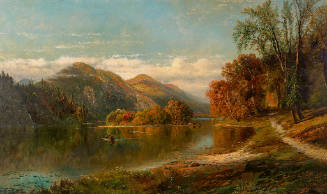
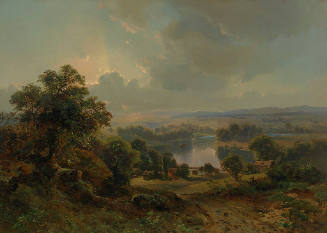
Born into Philadelphia's elite society, Lewis thrived as a prolific painter throughout his life. Appealing to the popular demands of the day, he painted grandiose landscape scenes that demanded awe and reverence for the divinity of nature. This is particularly evident in The Susquehanna at Duncannon where the landscape is natural in subject matter but contrived through Lewis' controlled representation of it.
Lewis' continuous search for impressive subject matter necessitated travel throughout the east coast. He utilized the train as a means of transport and found worthy landscape scenes along the railroad lines.(1) Pennsylvania, Lewis' home state, remained as one of his favorite destinations. He explored several of Pennsylvania's most distinct locations yet created many similar compositions. His "Claudian" landscape, adapted from prototypes by the French 17th century painter Claude Lorrain, includes a dark foreground enclosed on both sides and a strongly lit middle ground. This composition was common in Lewis' large scale canvases yet only accounts for some similarity.(2) The primary reason that numerous canvases resemble one another is because Lewis had found a panoramic composition that conveyed the sublime essence of nature and subsequently had transposed the scene that he was currently painting into this generic composition.
The Susquehanna at Duncannon is an excellent example of this process. Firstly, the "Claudian" landscape is evident through the specific location of dark and light values throughout the canvas. Secondly, however, strong evidence exists that when Lewis found an appropriate site, he would produce from it variations of similar compositions. This is the case in his paintings entitled View on the Susquehanna River from 1872 (3) and East Park, Philadelphia from 1876.(4) The Susquehanna at Duncannon, painted in 1872, is also extremely similar to Lewis' A View of the Centennial Exhibition, Philadelphia from 1876.(5) Although this is a completely unique setting and painted four years later, the composition as well as several elements within it are virtually identical to The Susquehanna at Duncannon. In both paintings Lewis utilizes the same compositional devise: a bridge with a train on it which serves to divide the sky and river as well as to join the two sides of the canvas.
As a talented artist, however, Lewis did incorporate elements into each composition that enabled it to be distinguished as unique to a certain site. Through several elements, including the outline of the city in A View of the Centennial Exhibition, Philadelphia and the riffles in the river in The Susquehanna at Duncannon, each canvas is individualized.(6) This altered rendering of a specific landscape enabled Lewis to be the prolific painter that helped form his reputation. The Susquehanna at Duncannon exemplifies his desire to convey divinity through the perfect, albeit manipulated, subject of nature.
A.L.B.
1 Edmund Darch Lewis, exh. cat.. (Philadelphia, PA: Woodmere Art Museum, 1985), p. 11.
2 Cotte, Sabine, Claude Lorrain, les Carnets de Dessins (New York: Henri Screpel, 1970), p. 74.
3 Illustrated in The Artistic Image, September 4th through November 20, 1985, exh. cat. (New York: Woodmere Art Museum., 1985), p. 9.
4 Illustrated in Woodmere Art Museum, 1985, p. 9.
5 Illustrated in American Watercolors, Drawings, Paintings, and Sculpture of the 19th and 20th Centuries, March 12, 1992, sales cat. (New York: Christie, Manson & Woods International, 1992), p. 33.
6 Appalachian Landscapes: With Naturalistic Eyes, exh. cat. (Carlisle, PA: The Trout Gallery, 1989), p. 21.
;This biography from the archives of AskART.com.
Edmund Darch Lewis is best known for his marine watercolors. He lived and worked in Philadelphia, studying for five years under the direction of Paul Weber. His works were first shown at the Pennsylvania Academy of Fine Arts in 1854 and then later at the National Academy of Design in New York and the Boston Athenaeum.
The Philadelphia, New York, and New England areas became the focus of his landscapes, especially the region known as the Delaware Water Gap in Western New Jersey.
Lewis keen vision and remarkable talent created great public demand for his work, inspiring the artist to produce up to three paintings a day. At times, the sales of his paintings exceeded those of all other painters in America. Although his oeuvre made him one of the most financially successful artists of the nineteenth century, Lewis was also well known for his large collection of furniture and China, which he amassed later in life.
Credit: Web site of Comenos Fine Art