Severin Roesen
Severin Roesen (birth & death dates unknown, active 1847-1872) came to the U.S. from Germany. Very little can be verified concerning his early life. A Severin Roesen is listed as exhibiting a flower painting in Cologne, Germany in 1847, and the same artist appears a year later exhibiting two flower pieces in New York City at the American Art-Union. He continued to exhibit there until 1852, the year of the Union's demise. It can be assumed that Roesen arrived in this country as a young, but already practicing artist.
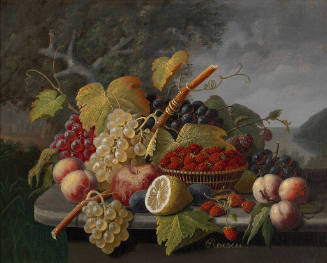
Throughout his career Roesen remained consistently devoted to still-life painting. According to Historian William H. Gerdts, Roesen's flower and fruit paintings seem related to Dutch works of the 17th and early 18th centuries. "Roesen appears to have introduced a form of still-life painting into American art which was . . . almost unknown here, at a propitious time for such an introduction. . . . his still lifes were often large, bountiful works: luscious combinations of fruits or flowers or both . . . the fruit resting on marble ledges . . ." Grape tendrils often appear in Roesen's compositions, and are frequently utilized in forming his signature, an "S-in-Roesen script." (This characteristic signature is not visible in Still Life With Fruit and Champagne Glass.)
"Roesen's methodology is an extremely synthetic one. While he may have worked, in part at least, from actual objects, the size of so many of his works would preclude his dependence upon the 'living models,' which would spoil and perish before he could complete such works. It would seem that he may have had templates that he rearranged from painting to painting, for almost every element in a Roesen still life is repeated in other works, occasionally many times over." (Wm. H. Gerdts)
Roesen married another immigrant, Wilhelmina Ludwig, in New York around 1849 or 1850, and the couple had three children. It appears that Roesen moved to Pennsylvania after the third child was born, leaving his family in New York. His wanderings took him to Philadelphia, Huntington, and several other communities before settling in Williamsport, about 1862. He spent ten years in Williamsport and there are newspaper accounts and other local information about this "genial, though often alcoholic, disheveled, and impoverished painter." Roesen disappeared from Williamsport and from record in 1872, though there is a dated work from that year. Various reports indicate he died in Philadelphia, New York, or in Williamsport, but there are no death records to substantiate this information.
Trompe l'oeil painting was not Roesen's intent, though his still-life compositions were often "life size" in scale. Paintings depicting luscious combinations of flowers or fruit were quite popular in the middle years of the nineteenth century and were often referred to as "dining room pictures." To Roesen's patrons and contemporaries, these paintings were indicative of nature's bounty and of divine blessing upon the New World.