Elizabeth Shippen Green
This biography from the archives of AskART.com.
Elizabeth Shippen Green, born in Philadelphia in 1871, is noted for her many illustrations, which may be found in the pages of numerous books and magazines. Her gracious lines, solid compositions, and grasp of color are a testament to her mentor, Howard Pyle.
Green was the daughter of Jasper Green, engraver, illustrator, and Civil War corespondent who encouraged her early interest in art, expressed by drawing flowers as a child. After seeing Howard Pyles drawings in St. Nicholas, she was inspired to be an illustrator. At 18 years old, she enrolled at the Pennsylvania Academy of Fine Arts where she studied under Thomas Eakins, Robert Vonnoh, and Thomas Anshutz.
Green began illustrating womens fashions for store catalogs, newspapers, and occasionally childrens magazines while she was still in school at the Academy. At eighteen she published her first illustration, entitled Naughty Lady Jane, in the Philadelphia Times, for which she received the munificent sum of fifty cents. She also spent six years studying abroad.
Green had already worked for the Ladies Home Journal, Saturday Evening Post, Harpers Weekly, and other publications when she enrolled in Howard Pyles class at Drexel Institute in 1894. There she met Violet Oakley and Jessie Willcox Smith, who would become her lifelong friends.
If Thomas Eakins can be credited with encouraging her solid draftsmanship, then Howard Pyle must be credited with teaching her how to apply it. Under his tutelage, his students were taught how to interpret life. Pyle had an enormous impact on all his students, not only because of his technical instruction, but also because of his positive, optimistic, and richly imaginative philosophy.
Elizabeth was named the first woman staff artist for Harpers Weekly, and worked exclusively for them from 1902 into the mid-twenties. Her work can also be found in advertisements for Kodak, Ivory soap, Elgin watches and Peerless ice cream freezers.
In 1901, Green moved into a house with Violet Oakley and Jessie Smith. Located in Villanova, Pennsylvania, they called it the Red Rose Inn. The three women lived there for many years, along with Elizabeth Greens parents and a friend, Henrietta Cozens, who was a skilled gardener and household manager. Smith and Green collaborated on a book, "The Book of the Child," in 1903, both contributing full-page color illustrations.
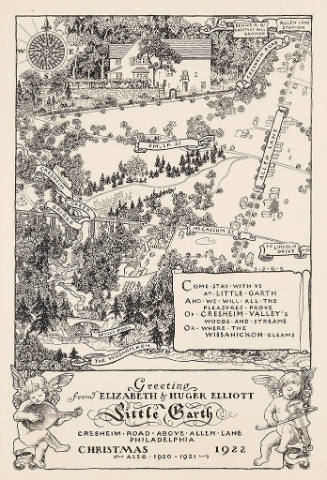
In 1905, the Red Rose Inn had been sold, and the women had to move. They moved to a farm in the country that they called Cogslea. At that time Green announced her engagement to Huger Elliott, an architect from Philadelphia and professor at the University of Pennsylvania. They did not marry, however, for another six years, as she did not want to burden him with the care of her parents. They remained engaged until her parents passed away, and married on June 3, 1911, when Elizabeth Green was forty. The couple then moved to Rhode Island, where Elliott became the director of the Rhode Island School of Design, and later to Boston and New York. Together, they collaborated on a book of illustrated nonsense verse. In 1951, after her husbands death, she retired to Philadelphia to be near her friends in her last years.
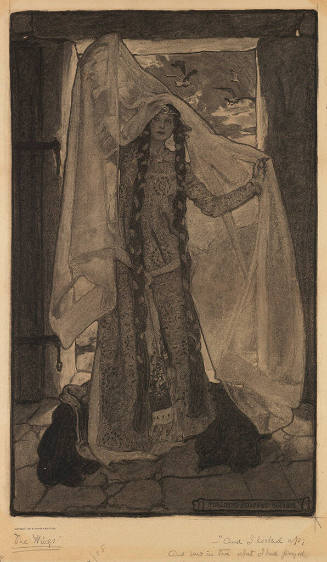
Green illustrated over twenty books, most of them after her marriage, and did countless pictures for leading magazines of her day. Her work was decorative and brilliant in color, exhibiting a similar style to her former roommates, Smith and Oakley, influenced perhaps by the Pre-Raphaelite movement and Art Nouveau. This decorative quality of her work was combined with the solid draftsmanship that had been encouraged by her teacher Thomas Eakins.
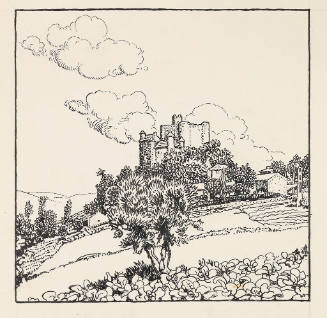
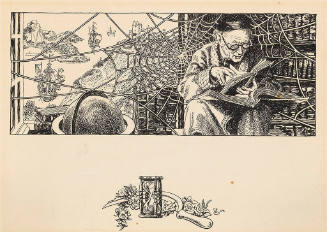
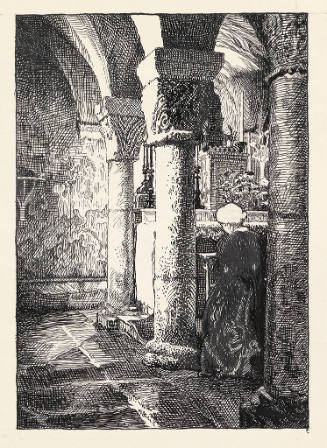
Using flat shapes with fluid but defining outlines of important elements, Greens work is suggestive of stained glass in her use of enclosed areas of brilliant color, which is not surprising considering her roommate, Oakley, was commissioned to do many stained glass windows. Greens drawing technique was similar to Smiths, often using a charcoal lightly sprayed with fixative, then layered with watercolor. Green was also noted for pen-and-ink work and for a strong style of line against mass.