Skip to main contentBiographyStuart Davis (American, 1894-1964)
As Stuart Davis’ abstract compositions continue to be examined, and his reputation as the most significant American abstract painter before the advent of Abstract Expressionism solidifies through such major museum retrospectives as the Metropolitan Museum of Art’s 1991-1992 exhibition Stuart Davis: American Painter, scholars have further studied Davis’ early years during which he worked in a figurative style and was associated with the Ashcan School.
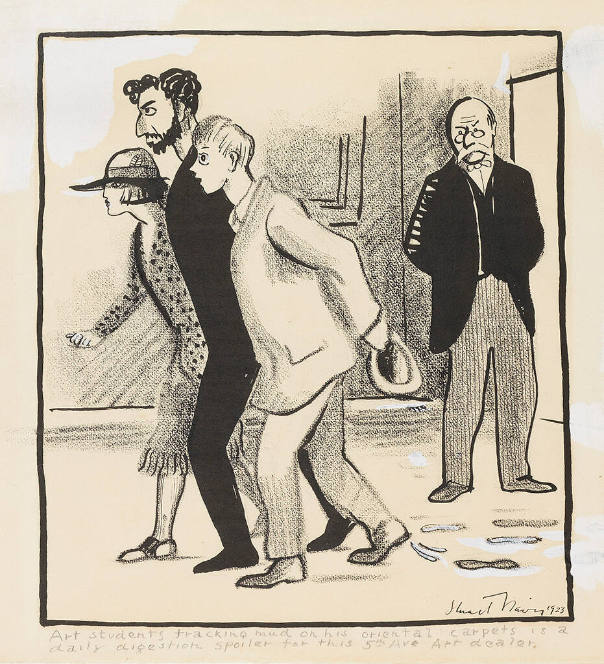
In fact, Davis was very much at the heart of the naming of this school. Around 1912-1914 a certain group of artists (Davis included) contributing to the populist New York socialist magazine called The Masses began to increasingly emphasize class distinctions in their work, satirizing the wealthy and portraying the poor not sentimentally but as truly disadvantaged. To other Masses artists, such as cartoonist Art Young, such a posture was politically irresponsible.
Referring indirectly to George Bellows’ drawing Disappointments of the Ash Can (reproduced in The Masses, February 5, 1914) in which three hungry hoboes inspect a worm-ridden ash can, Art Young declared that "they {these artists} want to run pictures of ash cans and girls hitching up their skirts on Horatio Street." Thus, the term was unwittingly coined in a negative context. It was the humorous, yet constant and antagonizing follow-up to Young’s statement by the dissenting artists (and particularly by Stuart Davis and close friends Henry Glintenkamp and Glenn Coleman) which made the ash can name stick. Masses managing director Max Eastman related the following anecdote: "Stuart Davis was walking in a downtown street with a friend the other day, and saw some pitiful Belgian of the industrial war making for the interior of a garbage can in search of a bite of food. ‘Look – he knows I’m a Masses artist!..." said Davis.
In the 1920s Stuart Davis labored to develop an idiomatic Cubism that translated the dynamics of the contemporary American environment into abstract color and shape. As he had been "enormously excited" by the Armory Show of 1913 (in which he had been able to include five of his watercolors), Davis steadily worked through his realist period and his brief Fauve period before turning towards Cubism. Yet Davis managed to avoid the Synchronist color abstraction of Morgan Russell and Stanton MacDonald Wright, as he did the New York Dada of Francis Picabia and Marcel Duchamp.
As Davis began simplifying and flattening objects to achieve structural clarity, his Cubist tendencies turned more towards the synthetic rather than the analytic, unlike fellow American Cubists Max Weber and Alfred Maurer. As a result, Davis’ compositions and his handling of color eventually became bolder than many of his contemporaries. In his own works Davis commented...
"A work of art should be first of all impersonal in execution. It may be simple but the elements that go to make it up must be positive and direct. This is the very essence of art – that the elements of the medium have a simple sense-perceptual relationship. The subject may be what you please…but in all cases the medium itself must have its own logic."
[Taken from internet web site of Comenos Fine Arts, www.comenosfinearts.com, 2/7/2000 --jag]


Stuart Davis
American, 1892 - 1964
As Stuart Davis’ abstract compositions continue to be examined, and his reputation as the most significant American abstract painter before the advent of Abstract Expressionism solidifies through such major museum retrospectives as the Metropolitan Museum of Art’s 1991-1992 exhibition Stuart Davis: American Painter, scholars have further studied Davis’ early years during which he worked in a figurative style and was associated with the Ashcan School.
In fact, Davis was very much at the heart of the naming of this school. Around 1912-1914 a certain group of artists (Davis included) contributing to the populist New York socialist magazine called The Masses began to increasingly emphasize class distinctions in their work, satirizing the wealthy and portraying the poor not sentimentally but as truly disadvantaged. To other Masses artists, such as cartoonist Art Young, such a posture was politically irresponsible.
Referring indirectly to George Bellows’ drawing Disappointments of the Ash Can (reproduced in The Masses, February 5, 1914) in which three hungry hoboes inspect a worm-ridden ash can, Art Young declared that "they {these artists} want to run pictures of ash cans and girls hitching up their skirts on Horatio Street." Thus, the term was unwittingly coined in a negative context. It was the humorous, yet constant and antagonizing follow-up to Young’s statement by the dissenting artists (and particularly by Stuart Davis and close friends Henry Glintenkamp and Glenn Coleman) which made the ash can name stick. Masses managing director Max Eastman related the following anecdote: "Stuart Davis was walking in a downtown street with a friend the other day, and saw some pitiful Belgian of the industrial war making for the interior of a garbage can in search of a bite of food. ‘Look – he knows I’m a Masses artist!..." said Davis.
In the 1920s Stuart Davis labored to develop an idiomatic Cubism that translated the dynamics of the contemporary American environment into abstract color and shape. As he had been "enormously excited" by the Armory Show of 1913 (in which he had been able to include five of his watercolors), Davis steadily worked through his realist period and his brief Fauve period before turning towards Cubism. Yet Davis managed to avoid the Synchronist color abstraction of Morgan Russell and Stanton MacDonald Wright, as he did the New York Dada of Francis Picabia and Marcel Duchamp.
As Davis began simplifying and flattening objects to achieve structural clarity, his Cubist tendencies turned more towards the synthetic rather than the analytic, unlike fellow American Cubists Max Weber and Alfred Maurer. As a result, Davis’ compositions and his handling of color eventually became bolder than many of his contemporaries. In his own works Davis commented...
"A work of art should be first of all impersonal in execution. It may be simple but the elements that go to make it up must be positive and direct. This is the very essence of art – that the elements of the medium have a simple sense-perceptual relationship. The subject may be what you please…but in all cases the medium itself must have its own logic."
[Taken from internet web site of Comenos Fine Arts, www.comenosfinearts.com, 2/7/2000 --jag]
Person TypeIndividual
Terms
- painters
- draftsmen (artists)