William Tylee Ranney
Profession: Genre, history, sporting and portrait painter
Studied: studied painting and drawing in Brooklyn, NY, beginning c.1833
Exhibited: NAD, 1838-57
Member: ANA, 1850
Work: North Carolina MA, Raleigh; J. B. Speed AM, Louisville; NAD; BMFA; Corcoran Gallery of Art; Thomas Gilcrease Inst., Tulsa, OK
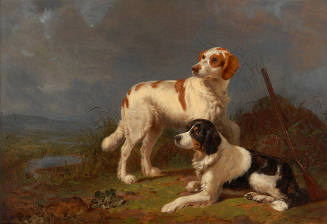
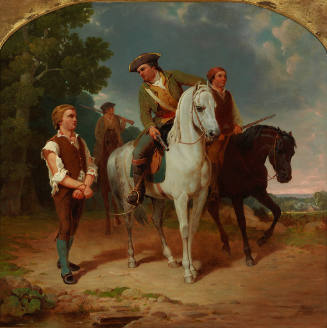
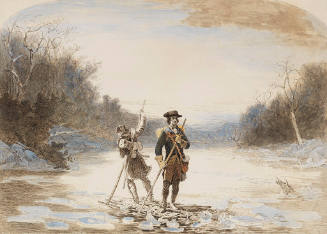
Comments: An important genre and historical painter, particularly of the Southwest. He lived in Middletown, CT, until his apprenticeship as a tinsmith began in 1826 (at age of 13) in Fayetteville, NC. By 1833, he was studying art in Brooklyn,and in 1836 he enlisted with the Texan Army in the war against Mexico. On his return to Brooklyn, about 1838, he painted portraits before opening his studio in NYC, which he kept from 1843-47. He then moved to more rural areas: in 1848 he was living in Weehawken, NJ and by 1850 he was living in neighboring West Hoboken, NJ, which was then developing as a rural artist colony. Ranney's time in Texas had put him in contact with trappers, guides, and hunters, and this became the recurring subject matter for his art from about 1846 (when he exhibited several western scenes at the NAD). His Hoboken studio, with its large accumulation of western objects, was said to resemble a pioneer's cabin. In addition to his western paintings, he also became known for his history pictures, a number of which related to George Washington and the Revolutionary War, and for his pictures of duck hunting in the Hoboken marshes. Ranney was well-respected by his fellow painters, in particular by William Sydney Mount who, after Ranney's death, helped arrange a memorial exhibition to benefit the artist's family. Mount also completed paintings that had been left unfinished in Ranney's studio. Ranney's works were also reproduced as engravings and distributed widely by the Am. Art-Union.
Sources: G&W; DAB; Cowdrey, NAD; Cowdrey, AA & AAU; NYCD 1843; NYBD 1844-50; Rutledge, PA; Rutledge, MHS; Karolik Cat., 462-64; Crayon, V (1858), 26, obit. More recently, see P & H Samuels, 389; Baigell, Dictionary; Gerdts, Art Across America, vol. 1: 232, 233 (repro.); 300 Years of American Art, vol. 1, 157
This biography is drawn from the "Who Was Who in American Art" , the reference book on the cultural life in the United States.