Edwin Austin Abbey
This biography was submitted by Pennsylvania Capitol Preservation Committee
Edwin Austin Abbey was one of the most celebrated artists of his day. Born in Philadelphia, he briefly studied art at the Pennsylvania Academy under Christian Schuessele. Before he was 20 years old, he was enjoying a brilliant career as an illustrator of poetry and drama for Harper’s Weekly. Then in the late 1870s, Abbey left America for England to pursue a career as a large-scale history painter. While in England, he was elected to the Royal Academy and admitted to the elite artistic circle of the Pre-Raphaelites.
As a result of his growing reputation at home and abroad, Abbey was about to undertake what would become his most famous commission. He was invited by American sculptor Auguste Saint-Gaudens in 1890 to produce the mural cycle The Quest for the Holy Grail for the McKim, Mead and White Boston Public Library, which was completed in 1901.
When Abbey was given his largest commission in 1902 to decorate the Rotunda, House and Senate Chambers, and the Supreme and Superior Court Room in the Pennsylvania Capitol, the artist knew that this monumental project inaugurated a new phase in his career. Thus he turned all of his energies to this project which he saw as his personal tribute to Pennsylvania and its history.
Abbey executed the Capitol murals in his studio in England. By the spring of 1908, all murals for the Rotunda were complete. They were exhibited at the University of London, where they received the highest acclaim. King Edward VII himself expressed regret that these magnificent paintings were leaving England. By 1909, the murals for the Capitol Rotunda had been shipped to Harrisburg and were leaving England. By 1909, the murals for the Capitol Rotunda had been shipped to Harrisburg and were placed at the collar of the dome. Four large circular canvases, fourteen feet in circumference, were installed in the pendentives. The four huge crescent-shaped murals, measuring 38 feet by 22 feet, were placed in the lunettes of the Rotunda.
When Abbey died suddenly in 1911, his widow administered the completion and installation of the House murals. The artist had completed three works for the House: The Apotheosis of Pennsylvania, Penn’s Treaty, and The Hours, the latter of which is located on the ceiling. The Reading of the Declaration of Independence for the House Chamber had been partially completed. This painting was finished by Ernest Board, a member of Abbey’s studio, under the supervision of John Singer Sargent. Only one mural had been executed for the Senate chamber entitled The Camp of the American Army at Valley Forge, February 1778. This painting, completed in 1910, had originally been placed in the Senate Chamber. As a result of Abbey’s untimely death, it was removed and relocated onto a north wall in the rear of the House of Representatives’ Chamber where it remains today.
This biography was submitted by The Caldwell Gallery (more Artists-1)
The following biography has been provided by The Caldwell Gallery.
Edwin Abbey, born in 1852 in Philadelphia, was a self-taught illustrator and muralist. He gained hands-on experience by working at a wood engraver's shop, emerging as an artist during the "Golden Age if Illustration" in the last half of the nineteenth century. Abbey studied briefly at the Pennsylvania Academy of Fine Art. In 1872 he went to work for Harper's Publishing and then transferred to England a few years later. It was here that he would remain, illustrating poems and literature with highly precise detail. In 1902 Abbey was appointed official court painter of coronation in Westminster Abbey.
Abbey's early work was rooted in naturalism but eventually became more stylized, often depicting flattened figures in a frieze-like arrangement, similar to techniques of Art Noveau. His oil paintings generally favored historical England. Abbey's murals can be seen at the Public Library of Boston, as well as Pennsylvania and Washington. The permanent collection is held in New Haven Connecticut.
--------------------------------------------------------------------------------
This biography from the archives of AskART.com.
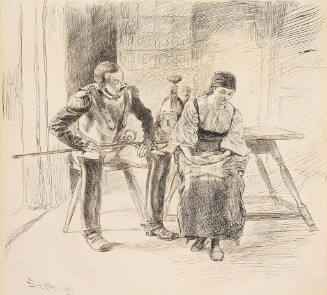
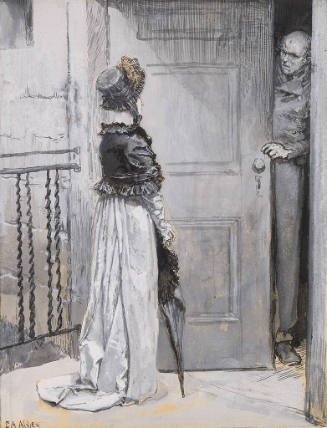
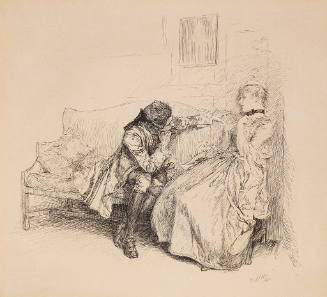
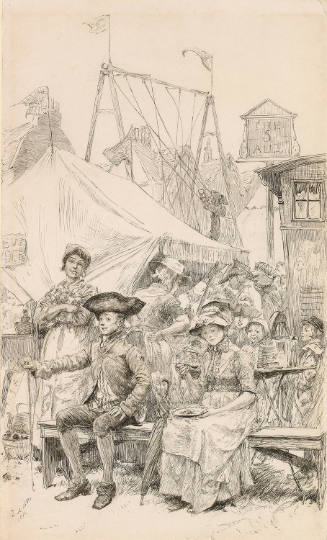
With encyclopedic knowledge of the Middle Ages and extensive study of costumes and interiors, Edwin Austin Abbey was "one of the greatest American illustrators of the 'Golden Age of Illustration' of the last quarter of the 19th century" (Falk). He was also a painter and muralist, known for historical subjects. For mural decorations in the Boston Public Library and the State Capitor in Harrisburg, Pennsylvania, he has received much attention, and he is regarded as unsurpassed for the brilliant draftsmanship of his pen and ink drawings of Shakespeare's plays. (Reed, 46).
He was born in Philadelphia and studied at the Pennsylvania Academy of Fine Arts with Christian Schussele and then beginning 1871, worked as an illustrator for "Harper 's Weekly" in New York City. There his associates included renowned illustrators Howard Pyle, John White Alexander, Charles Reinhart, and A.B. Frost.
In 1878, Harper & Brothers sent him to England to illustrate scenes from historic England and Shakespeare. Driven to create authentic illustrations, he decided to remain in England much of the time because of access to original props and costumes associated with historical events including references from Shakespeare's plays as well as other references in literature such as works by Alexander Pope and Andrew Marvell. In 1902, he became the official court painter at the coronation of Edward VII.
Although he became an expatriate, he returned often to the United States.
From the late 1890s, his work became much more stylized and could be categorized as Art Nouveau and Symbolist. He often crowded the outer edges of his canvas with large forms with figures arranged across the picture.
Credit:
Matthew Baigell, "Dictionary of American Art"
Walt Reed, "The Illustrator in America, 1860-2000"
Peter Falk, "Who Was Who in American Art"