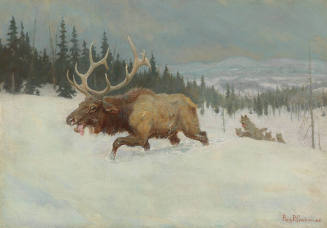
Philip R. Goodwin
This biography was submitted by The Coeur d' Alene Galleries L.L.C.
Philip Goodwin specialized in paintings depicting hunting, fishing, and cowboys of the west. He was influenced by C.M. Russell and visited the great artist on occasion. He studied at the Rhode Island School of Design and his illustrations appeared in many publications.
This biography was submitted by Drummond Gallery
Philip Goodwin was born in Norwich, Connecticut in 1881. Sketching was a consuming childhood pastime. He was eleven when he sold his first illustrated story to "Collier's" magazine. At seventeen he was a promising student of Howard Pyle at the Brandywine School at Chadds Ford, Pennsylvania, and a classmate of N.C. Wyeth and Frank Schoonover. He later attended the Rhode Island School of Design. Goodwin was also a member of the Art Students League in New York.
While still in his twenties, he became friends with Carl Rungius and Charles Russell, when all three artists maintained studios in close proximity in New York City. Thereafter, whenever possible, Goodwin spent his summers in the West. Probably influenced by Russell, Goodwin became adept at sculpting. After Russell's death, Goodwin helped Nancy Russell assemble the book of her husband's letters, "Good Medicine", which contains three of Russell's illustrations to Goodwin.
Sportsmen remember Philip Goodwin's large calendar prints, usually "predicament" paintings, which hung in mercantile establishments across the country during the twenties and thirties. There were also covers for "Outdoor Life" and "Saturday Evening Post" and advertising posters for Remington Arms and Winchester Arms. A very special painting, "Horse and Rider", became the trademark of the Winchester Company.
Goodwin never married; his lifelong commitment was to the field of illustration. In addition to commercial advertising commissions, he painted for a goodly number of leading authors. Notable among the many books that he illustrated were "Call of the Wild" by Jack London and "African Game Trails" by Theodore Roosevelt.
--------------------------------------------------------------------------------
This biography from the archives of AskART.com.
Known for his illustrations of hunting, fishing, and cowboy scenes, especially scenes featuring firearms, Philip R. Goodwin was from Norwich, Connecticut. By the age of eleven, he had already sold his first illustrations to Colliers magazine. He was educated at the Rhode Island School of Design in Providence and the Art Students League in New York. He also studied with Howard Pyle in Pennsylvania. His works exhibit much of Pyles earnestness and discipline, but are restricted almost entirely to subjects of hunting and fishing. In this limited area, however, he produced many notable pictures, the subject matter always convincing and dramatic in color.
In his early twenties, he established a studio in New York and met Charles Russell, whose paintings of western subjects provided a great influence on Goodwins work in that genre. Goodwins interest in scenes of cowboys and ranch life is evident in Bronco Buster. The two men traveled together on several occasions, sketching source material for their paintings. Meanwhile, Goodwin appeared in such books as Jack Londons Call of the Wild.
Goodwins pictures were also published in Harpers Monthly and Weekly, Outing, Scribners, and Everybodys magazines, in addition to calendar subjects for Brown & Bigelow, advertising for Winchester Arms and the Marlin Firearms Company. He also illustrated African Game Trails for Theodore Roosevelt. Goodwins interest in Charles Russell is seen not only in Goodwins use of bright, vivid colors, but also in the romanticized subject matter, which appears to celebrate the bonding of rider and mount.
(Information on the biography above is based, in part, on writings from the book, "The Illustrator in America, 1880 1980", A Century of Illustration, by Walt and Roger Reed.)