

The Last of the Chestnuts
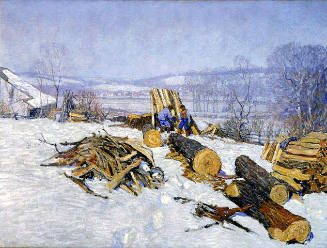
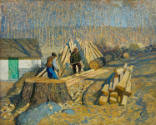
- Splitting Fence Rails; The Last of the Chestnut Trees, Chadds Ford; Two Men Splitting Logs
The chestnut blight was accidently introduced to the United States about 1904. Letters N. C. Wyeth wrote as early as March 1912, document the effect the chestnut blight had on the trees on his property in Chadds Ford: "Our chestnut trees are bound to go! So say the tree experts. It makes me sick to think of it" (Betsy James Wyeth, ed., The Wyeths, The Letters of N. C. Wyeth, 1901-1945. Boston: Gambit, 1971, p. 409)
This painting probably dates from the fall of 1916 when the "skeleton chestnuts" were still standing (NCW to Henriette Zirngiebel Wyeth, Sept. 15, 1916, Wyeth Family Archives). Wyeth captured a local work crew probably hewing fence rails; he used an impressionist style with which he was experimenting, one inspired by his interest in the work of the Swiss Italian artist Giovanni Segantini (1858-1899). An archival photograph in the collection of the Brandywine River Museum of Art shows the canvas before the addition of tree trunk shadows on the roof of the shed and on the ground at the right side of the painting.
No documentation dating from the artist's lifetime provides a title for this painting. It was first referred to as The Last of the Chestnuts in the catalogue that accompanied an exhibition at Knoedler Gallery in 1957.