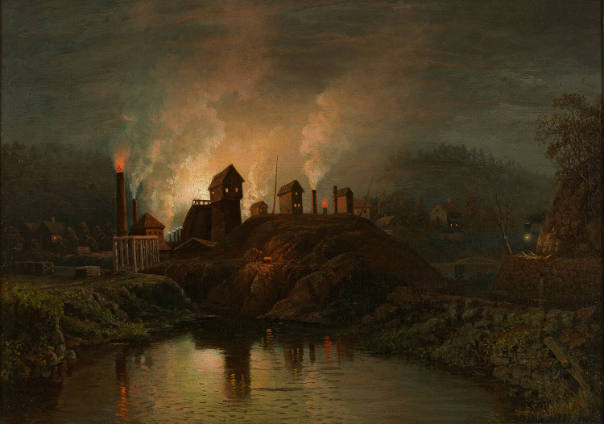

The Atkins Furnaces, Pottsville, Pennsylvania
George Cope was born in 1855 near West Chester, Pennsylvania, and spent most of his life in the Chester County area. He originally trained with German landscape artist Hermann Herzog, who lived in Philadelphia from the 1860s. In his early career, Cope painted several landscapes of the countryside close to his home in Chester County, as well as in his travels to the Poconos and New York lake regions with Herzog, and in the western U.S. during his travels across America.
Inscribed on the original wooden stretcher of this painting were the subject and location of this landscape – Atkins Furnaces, Pottsville, Pennsylvania. The buildings depicted here were constructed in 1852 in southeast Pottsville, then acquired in 1864 by Charles M. Atkins, president of the Pottsville Iron and Steel Company. In this painting, Cope used an evening setting, which serves to dramatize the effect of the fiery furnaces, illuminating the sky above them.
While this painting is not dated, there are clues in the work that help to estimate when it was made. For example, this scene contains a railroad truss bridge on the left and a steam engine and train tracks on the right. The Pennsylvania Railroad did not extend to Pottsville until 1886, so it is likely this was painted sometime after that date. In addition, Charles M. Atkins died in late 1889, and under his son’s leadership, the Pottsville Iron and Steel company ran into financial difficulties in the middle 1890s, when several of their furnaces were shuttered and workers were laid off. The company was eventually sold in 1899.
Although industrial landscapes were unusual subjects for Cope, he painted Atkins Furnaces in Pottsville twice. This is the smaller of the two paintings; the other is entitled "American Iron Mill, Pennsylvania," which is in the collection of the Westmoreland County Museum of Art, in Greensburg, Pennsylvania. Painting multiple versions of the same subject was a common practice for Cope, especially with his more pastoral landscapes.