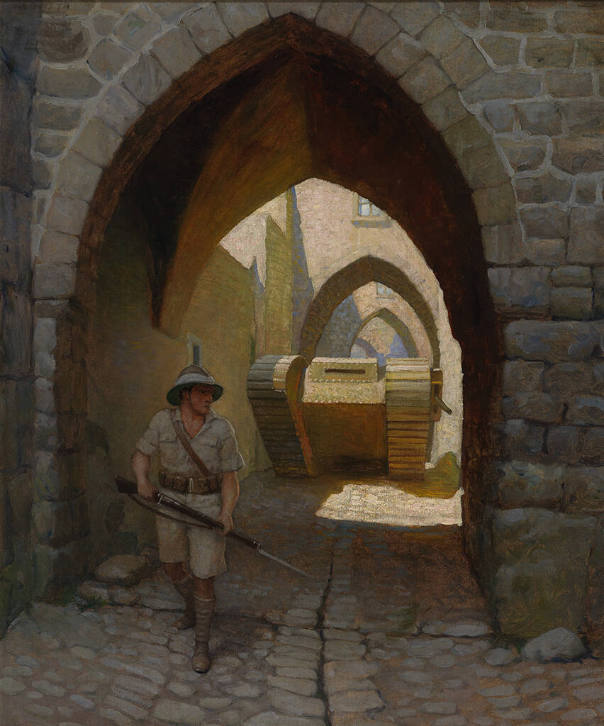
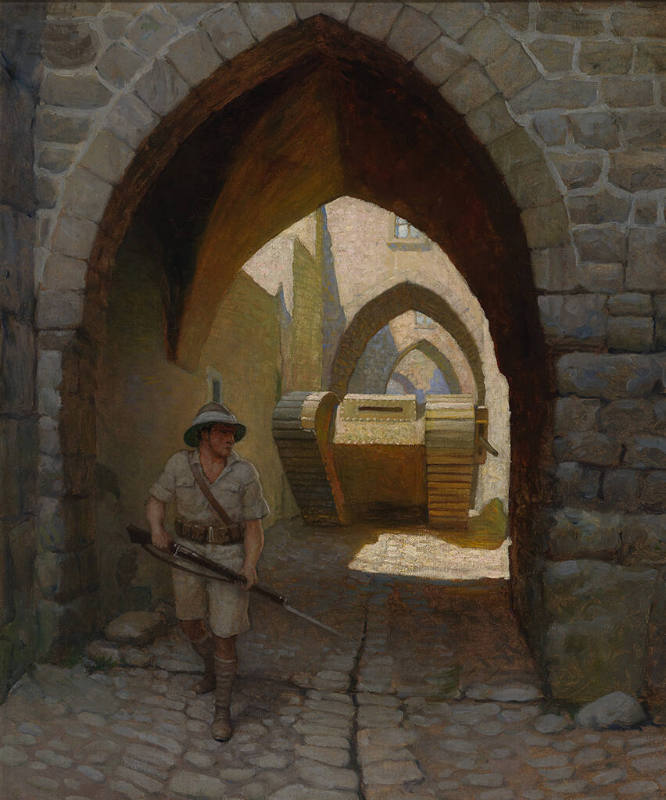
The Twentieth Century and the First The Dramatic Contrast of an English Tank in the Streets of Jerusalem
Despite Howard Pyle’s advice to paint what you know, N. C. Wyeth turned down several offers and military commissions to travel to the battlefields of Europe during World War I. Without the actual experience, he compensated by amassing a large collection of photographs, newspaper clippings and artifacts pertaining to the war. He also sought out returning veterans for their first-hand accounts.
In a January 1918 letter to his mother, Wyeth wrote, "It has been a busy, busy week. In the past eight days I shall have all but completed two pictures (of a set of four) for Red Cross Magazine depicting the British occupation of Jerusalem, trying to bring out dramatically the sharp contrast of the new as against the old…[in one], a regiment of British soldiers—or possibly a "tank" (if I can find out authentically that these modern leviathans entered the Sacred city) passing under the Arch de Ecce Homo, the arch under which Christ passed bearing the cross!" (NCW to Henriette Zirngiebel Wyeth, Jan. 26, 1918, Wyeth Family Archives) Although the magazine published the four pictures, Wyeth later complained that the pictures weren’t as well received as he had hoped. "The pictures lacked sensationalism in its cheaper form is my conclusion, and to that extent shot over the heads of the magazine men." He aptly summed up the advances in information technology with the prescient comment that the art editors "are comparing art with moving pictures…trying to do the impossible and to create that obvious and striking sensationalism of the cinemetograph in their magazine."