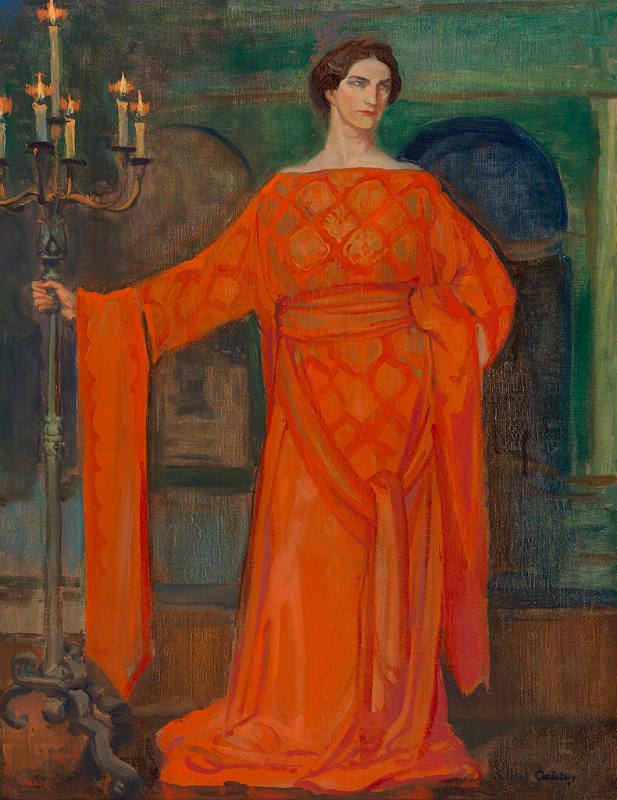
Seven Branched Candlestick
Born in Jersey City, New Jersey, Violet Oakley was among the leading female students of illustrator Howard Pyle. She attended his classes at the Drexel Institute beginning in 1896, though she also studied at the Art Students’ League and the Pennsylvania Academy of the Fine Arts.
An incredibly versatile artist comfortable in many media, she worked on ambitiously scaled projects in stained glass design and mural painting, including forty-three murals for the State Capitol building in Harrisburg, Pennsylvania. She had a particular affinity for William Penn and the history of the Quakers, the subject of a thirteen-mural cycle in the Capitol. Oakley was a Christian Scientist, a feminist, and a pacifist, and deeply admired William Penn for his Quaker tenets of nonviolence, religious tolerance, and racial equality, ideals that she also passionately and actively supported.
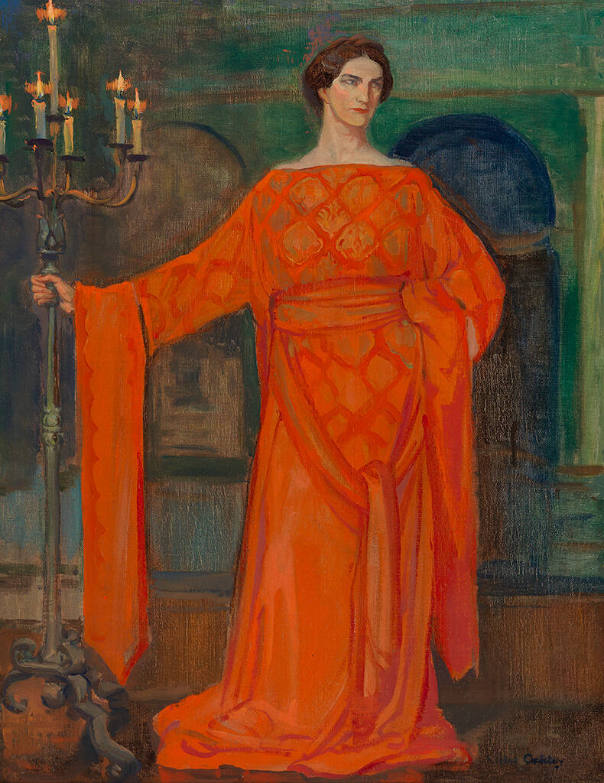
In "Seven Branched Candlestick," we see a full-length view of a standing woman adorned in an elegant and loosely-tied red-orange gown, embellished with a gold pattern and long, flowing sleeves. Her left-hand rests on her hip, while her right hand holds the base of a seven-branched candlestick. The model is Mary Nixon, Oakley’s friend and extended family member, who ran the Florentine School for Girls in Florence, Italy. In a 1916 photograph of Nixon modelling for a different painting, she is seated in Oakley’s studio in front of a study for one of the Capitol murals, with an elaborate candelabra by her side. A portion of the same mural study and candelabra appear in "Seven Branched Candlestick." This composition appears to be related to a poster Oakley executed entitled "For the Preservation of Italy" (undated, Pennsylvania Academy of the Fine Arts) in which the model, in the same pose and in similar dress, holds a battle axe rather than a candelabra.