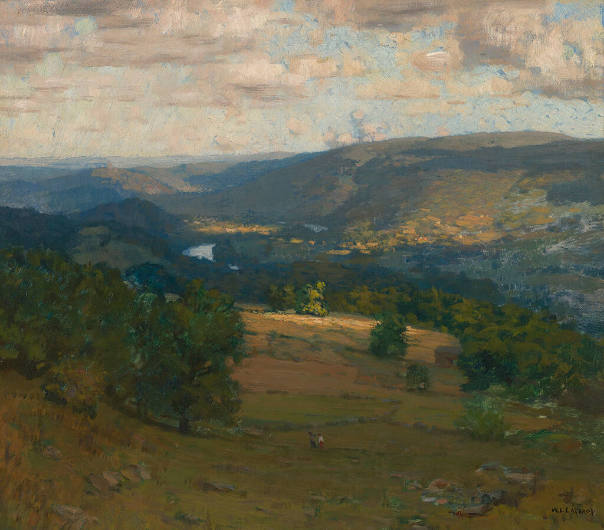

The Delaware Valley
Originally from Painesville, Ohio, William Langson Lathrop moved to New York City and in the 1870s began his career as an illustrator. He worked for Harper’s magazine, among other publications, and then as an etcher for The Photoengraving Company. He studied briefly at the Art Students League in 1887 with William Merrit Chase and then traveled abroad. In England, Lathrop sketched and painted with American artist Henry Ward Ranger, who introduced him to Tonalism, a progressive American art movement that developed in the 1880s out of an abiding spiritual feeling for the landscape. Lathrop often painted landscapes at dawn or dusk with soft effects of light and shadow as if seen through a misty or colored veil.
Completed around the time Lathrop moved to New Hope, Pennsylvania, this painting reveals the lingering influence of Tonalism in the artist’s softly rendered forms and selective use of light. Lapthrop’s dramatic, bird’s-eye perspective creates a remarkable sense of depth, underscored by the dramatic horizon line and contrast between the sky and outline of the hills dissolving into the distance.
Lathrop, along with Edward Redfield, was instrumental in founding what is called The New Hope School; his studio, where he also taught, became a focal point of this active art colony. For the next three decades Lathrop worked there, his painting style evolving from the moody style of Tonalism into a brighter Impressionist palette accompanied by a looser brushstroke—the paintings for which he is perhaps best remembered today.
There are no works to discover for this record.