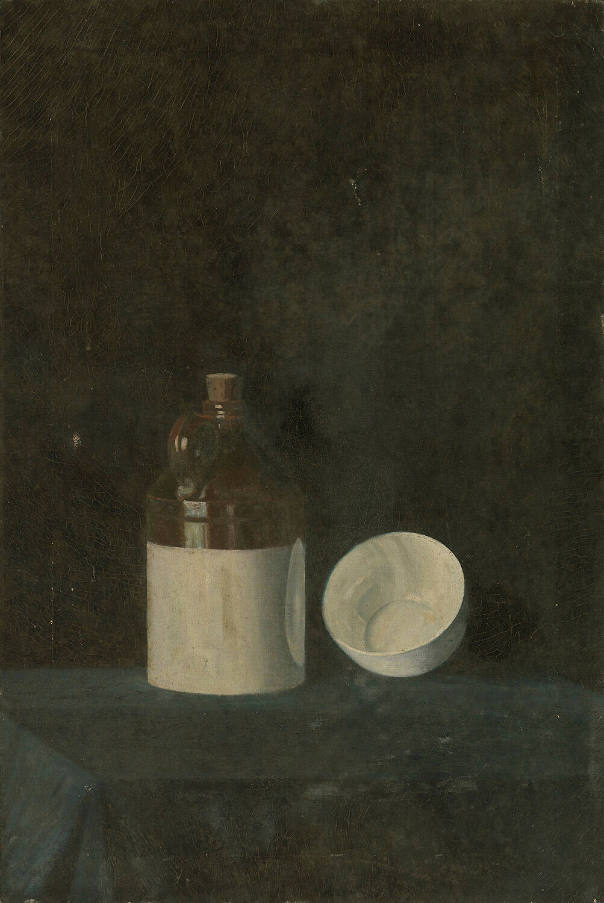
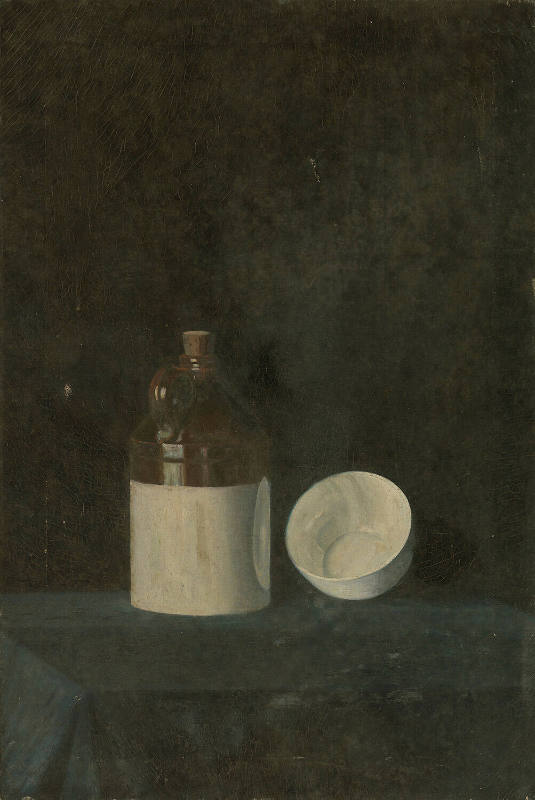
Still Life of Stone Jug
Peter Hurd (1904-1984) was a painter, illustrator, muralist, and lithographer. Born and raised in Roswell, New Mexico, he had strong ties to the region and was often described as a regionalist painter of the American Southwest. In 1921 he traveled East to attend West Point, from which he resigned (in good standing) after two years in order to pursue his true calling as an artist. He subsequently moved to the Philadelphia region and enrolled at Haverford College to study liberal arts.
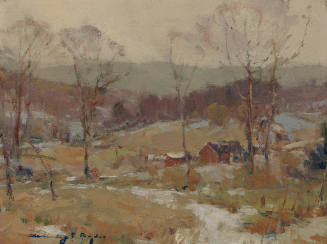
In late 1923, when he was 19 years old, Hurd became acquainted with the famous illustrator, N. C. Wyeth, who he persuaded to accept him as a pupil in 1924. Hurd therefore left Haverford College after one semester and moved to Chadds Ford, PA, where he lived with the Wyeth family, attended the Pennsylvania Academy of the Fine Arts, and began studying under N. C. Wyeth, which he did for about six years. Many of Hurd’s early works were inspired by the farmland and gentle rolling hills of the Chadds Ford area. In 1929, Hurd married Wyeth’s eldest daughter, Henriette Wyeth, and in the late 1930s the two moved back to Hurd’s home state of New Mexico, where they lived on their ranch, not far from Roswell.
Throughout his career, Hurd primarily painted portraits and landscapes, which makes "Still Life of Stone Jug" interesting—Hurd painted very few still lifes during his career. However, the artists who surrounded Hurd during his time in Chadds Ford were frequent painters of still lifes, including N. C. Wyeth, Henriette Wyeth, Carolyn Wyeth, and John McCoy, who later became Hurd’s brother-in-law. In addition, these Chadds Ford artists often painted still lifes containing a stoneware vessel alongside what appears to be a china or porcelain dish in a standard studio set-up for training, just as we see in "Still Life of Stone Jug." In fact, N. C. Wyeth devoted some of his own time to painting still lifes, and to thinking about how to translate three-dimensional space and light in and around objects into a two-dimensional image. According to members of his family, N. C. was able to talk for the better part of an hour about the universe implicit in the hollow of a bowl, the spin of universal light on its rim, and his ideas around space in the background.
This painting by Hurd is likely the result of time spent with the Wyeths and members of their extended family during his studies with N. C. Wyeth in his Chadds Ford studio, sometime between 1925 and 1929.