Dory and Sprits'l
Peter Hurd (1904-1984) was a painter, illustrator, muralist, and lithographer. Born and raised in Roswell, New Mexico, he had strong ties to the area and was often described as a regionalist painter of the American Southwest. In 1921 he traveled East to attend West Point, from which he resigned (in good standing) after two years in order to pursue his true calling as an artist. He subsequently moved to the Philadelphia region and enrolled at Haverford College to study liberal arts.
In late 1923, when he was 19 years old, Hurd became acquainted with the famous illustrator, N. C. Wyeth, who he persuaded to accept him as a pupil in 1924. Hurd therefore left Haverford College after one semester and moved to Chadds Ford, PA, where he lived with the Wyeth family, attended the Pennsylvania Academy of the Fine Arts, and began studying under N. C. Wyeth, which he did for about six years. Many of Hurd’s early works were inspired by the farmland and gentle rolling hills of the Chadds Ford area. In 1929, Hurd married Wyeth’s eldest daughter, Henriette Wyeth, and in the late 1930s the two moved back to Hurd’s home state of New Mexico, where they lived on their ranch, not far from Roswell.
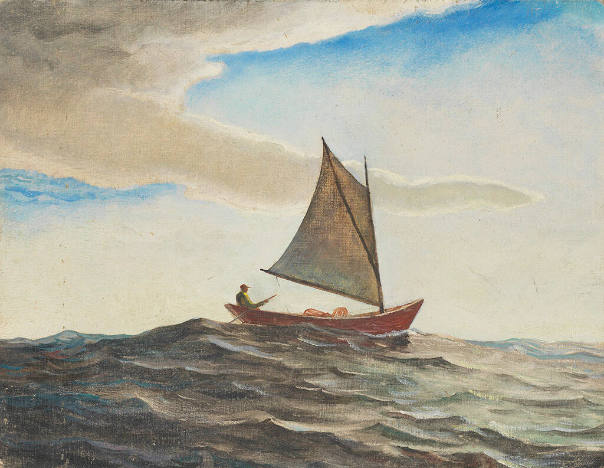
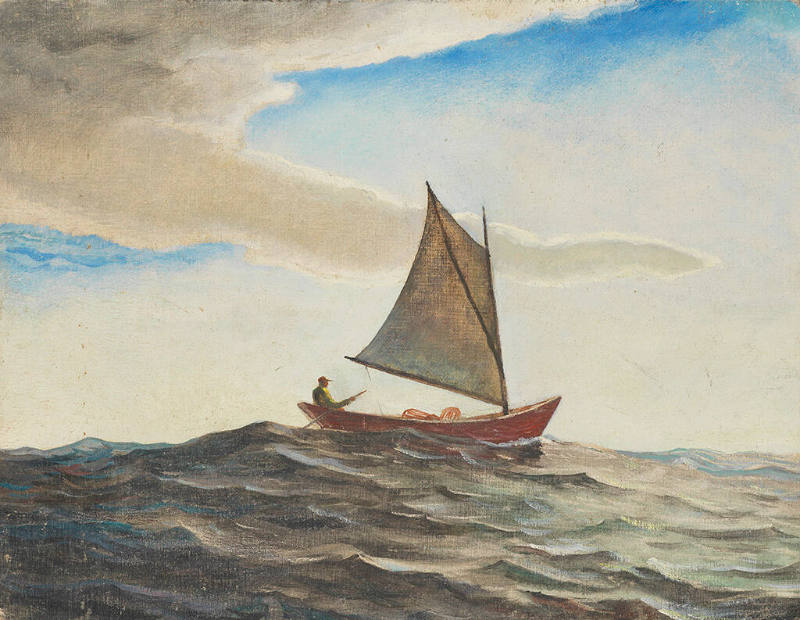
This is a painting of a dory, a small fishing boat with a flat bottom and a sharp bow, which came in many varieties. The boat in this image may be a Swampscott dory, which was used from the middle of the nineteenth century by fishermen along the North Shore of Massachusetts, and eventually along the coast into Maine. The sprits’l, or spritsail, is a four-sided sail that has the additional support of a diagonal spar, or sprit, as can be seen in this painting. While seascapes were a rare subject for Hurd, this painting was likely inspired by the holidays he spent at the Wyeth’s summer home in Port Clyde, Maine, which mostly took place prior to WWII and N. C. Wyeth’s death in 1945.
In "Dory and Sprits’l," a fisherman transports lobster traps in his dory, steering through a sea that appears to be growing evermore dark and choppy under an increasingly stormy sky. Here, Hurd’s clouds imitate two large arms reaching out as if they will snare the boat. Even though the dory takes up a good portion of painted surface, it seems on the verge of being overwhelmed by the growing turbulence of the sea.
Both N. C. and Andrew Wyeth painted several works of lobstermen in their dories, as did Winslow Homer, who was greatly revered by the Wyeths.