A Night with Little Sister
After moving from Nebraska to New York City, Rose Cecil O’Neill found herself living in a modern era that had a strong influence on her style: she developed a decorativeness in her work based in part on the flowing linearism of art nouveau. As O’Neill’s unique style emerged, she illustrated regularly for Truth, Collier’s, Harper’s, and Life.
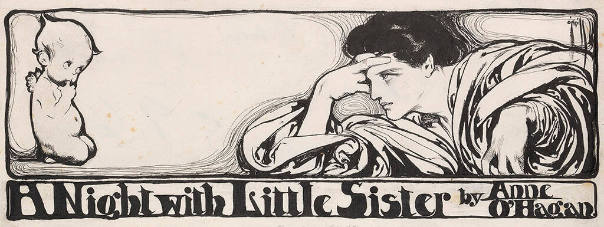
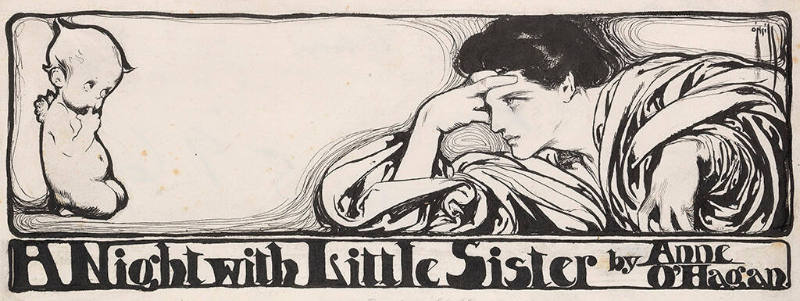
Along with her success as an illustrator, O’Neill’s fame rested primarily on her invention of the Kewpie Doll, her personal transformation of Cupid. The Kewpie, figured prominently in her illustrations, often shown as a mythical character that solved problems. O’Neill’s Kewpie first appeared after the turn of the century. A Night with Little Sister, a small pen and ink drawing used as a chapter heading, is an early rendition of the figure: this Kewpie has tiny wings, large eyes, and distinctive baby-fine hair. Kewpie was the voice of love. In the story, "A Night with Little Sister" the protagonist’s concern was the modern woman’s predicament: marriage versus career. It was Kewpie’s task, as the voice of love, to listen to and guide the heart in its conflict with the mind.